Apple cider braised pork shoulder is the kind of Sunday supper that mostly cooks itself. A bone-in roast goes into the Dutch oven with sweet cider, onions, and herbs, then comes out hours later so tender it shreds with the nudge of a fork. The cooking liquid doubles as the sauce!
Three more pork shoulder favorites:

Before You Get Started
Braised pork shoulder is forgiving, but three decisions shape how it turns out. Get these right and the rest is mostly waiting:
- Buy a bone-in Boston butt: The marbled fat and the bone both add flavor and moisture. Boneless works, but it cooks a little faster.
- Surround the pork, don’t cover it: The liquid should come about halfway up the roast. Too much and you’re boiling rather than braising.
- Use fresh cider, not juice: Look for cloudy, unpasteurized cider with no added sugars or spices. Apple juice is thinner and much sweeter.
How to Make Braised Pork Shoulder
Braising is a two-part method: a hot sear for color and flavor, then a long, slow, covered cook in liquid until the tough connective tissue melts. Here’s how it goes in a Dutch oven:
Step 1: Start with a Dry, Well-Seasoned Roast
Blot the roast all over with paper towels. A dry surface is what lets the meat brown instead of steam, so don’t skip this.
Season liberally with salt and pepper on every side, including the fat cap.
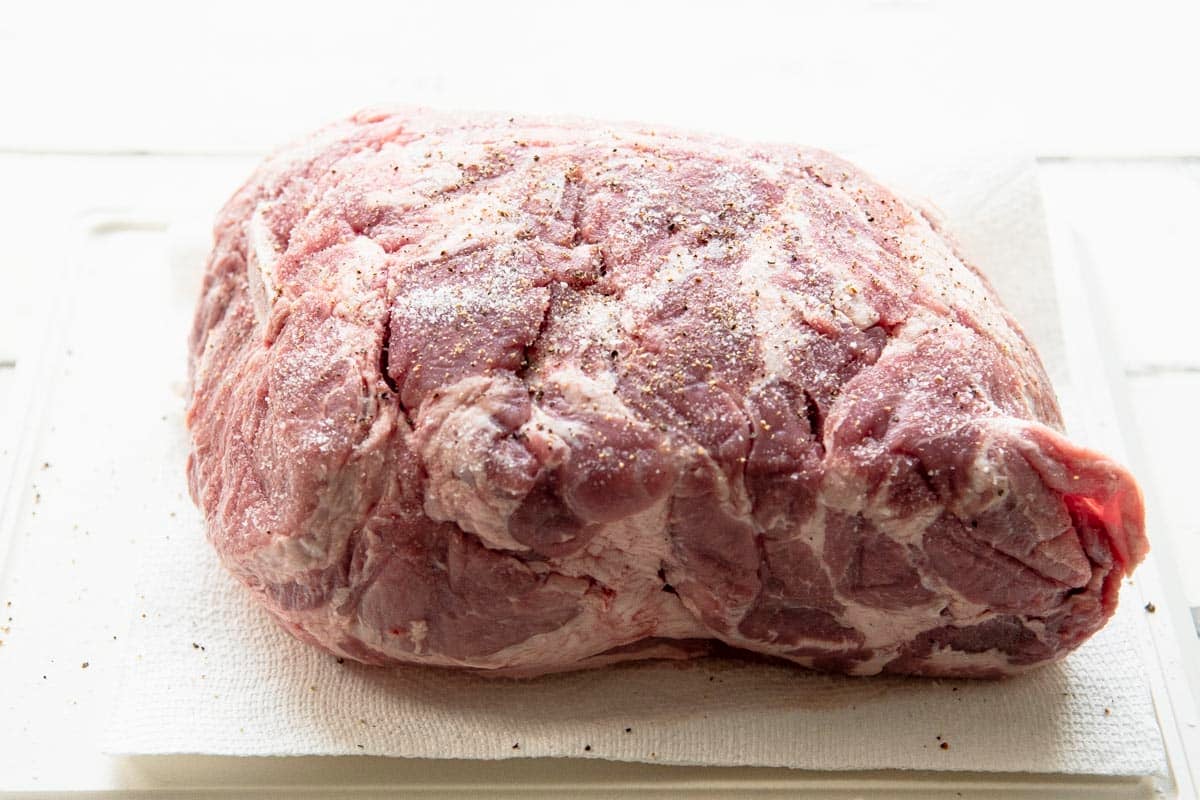
Step 2: Sear on All Sides
Heat the oil in a large Dutch oven over medium heat and brown the pork about 6 to 7 minutes per side. That golden crust comes from the Maillard reaction, and it’s where a lot of the finished flavor lives.
Keep the heat moderate so the drippings in the bottom of the pot toast rather than burn.
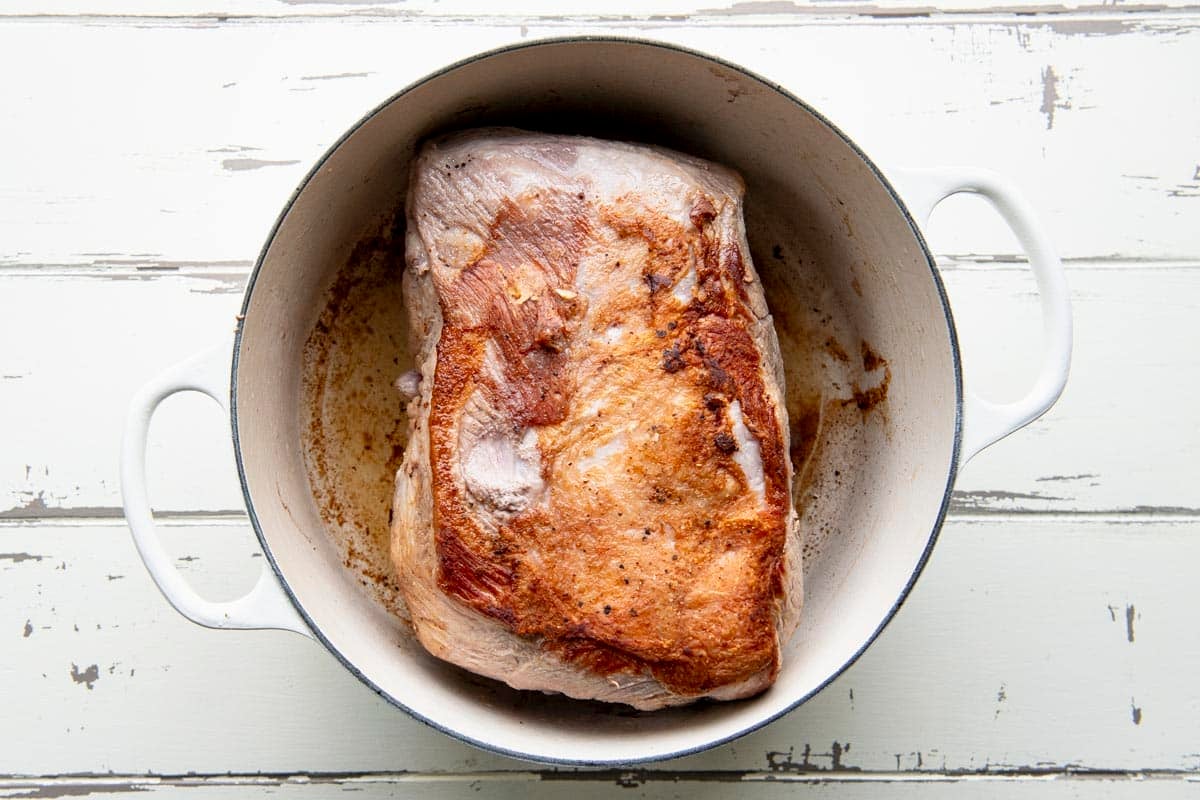
Step 3: Sauté the Onions and Garlic
Pull the pork out to a platter and add the sliced onions and garlic straight into the drippings.
Cook 10 to 15 minutes, until the onions are soft and starting to pick up color. They’ll melt into the sauce by the end.
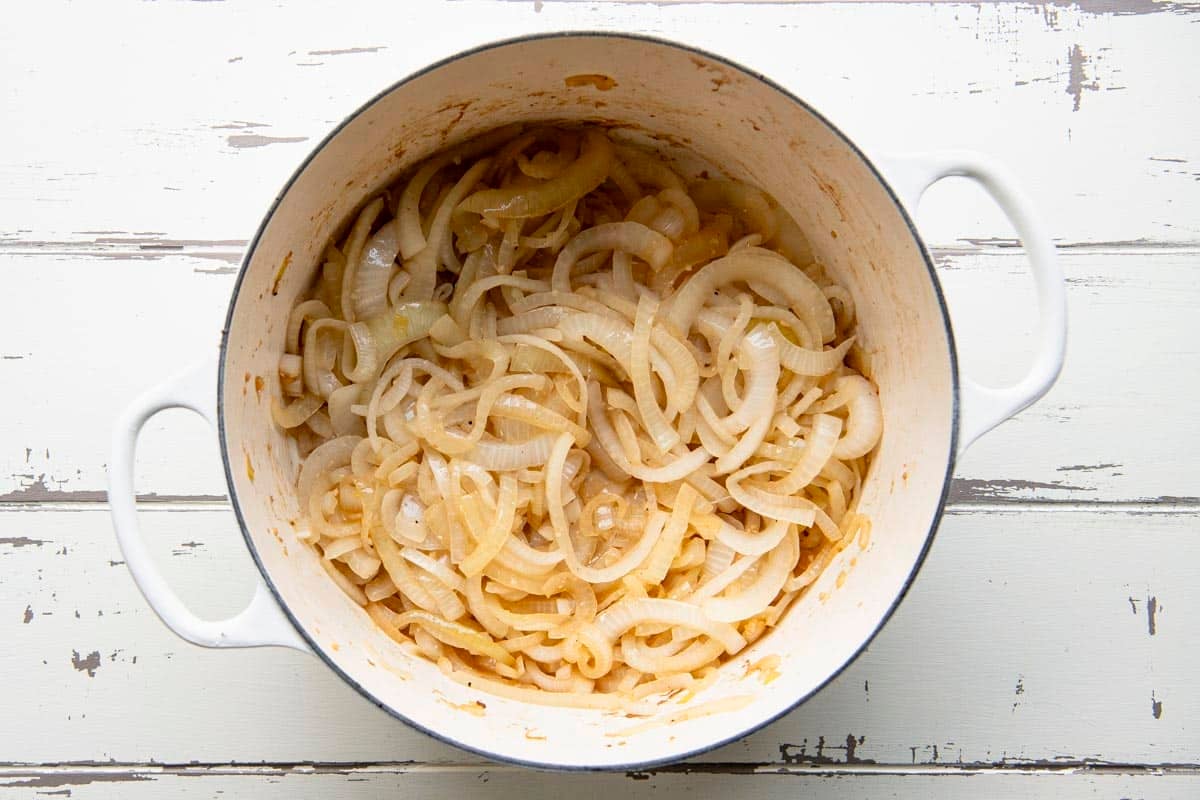
Step 4: Build the Braising Liquid
Stir in the salt, bay leaf, thyme, rosemary, apple cider, and chicken broth, scraping up the browned bits from the bottom of the pot.
⇢ Decide how apple-forward you want it: Cider plus broth gives you a balanced, savory sauce. Swap the broth for more cider and you’ll get a sweeter, more pronounced apple flavor.
⇢ Add sliced apples if you like: Tuck a couple of firm apples like Granny Smith around the roast in the last hour so they hold their shape instead of dissolving.
Step 5: Return the Pork to the Pot
Return the roast to the pot fat-side up, so the fat bastes the meat as it renders. The liquid should reach roughly halfway up the sides and no higher.
Put the lid on tight.
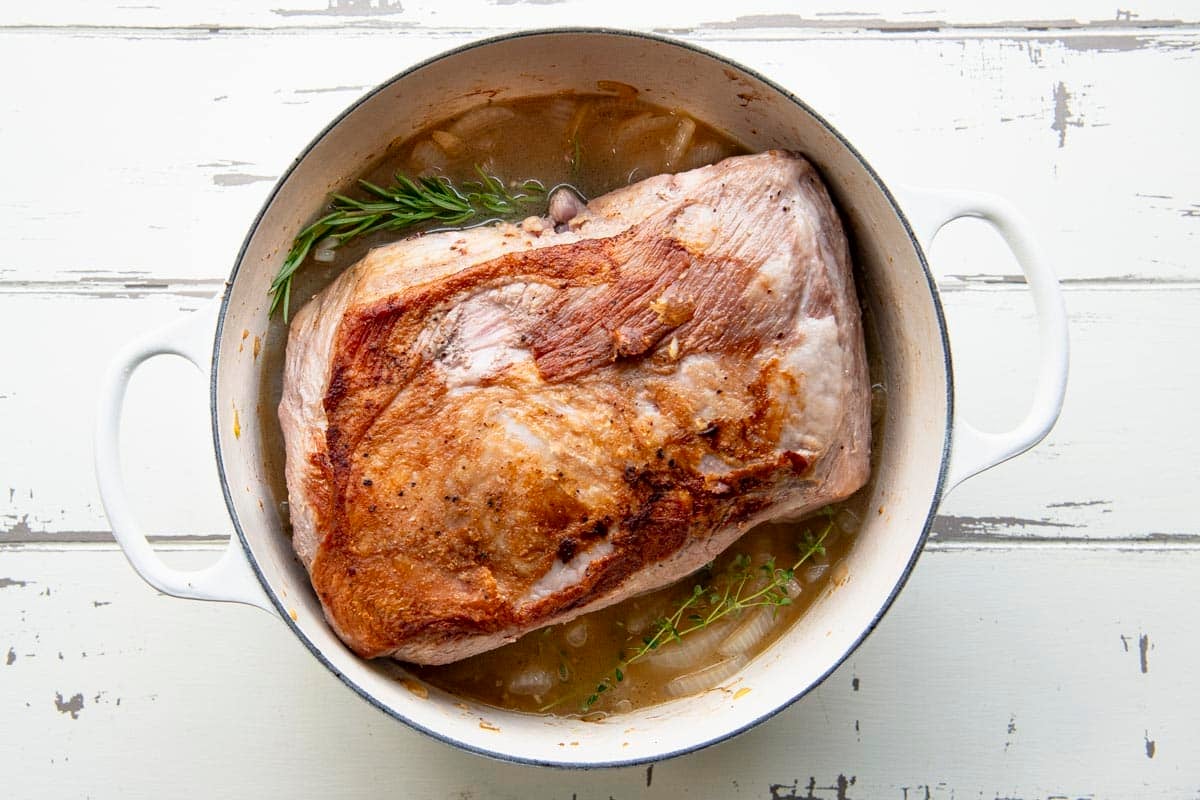
Step 6: Roast Low and Slow
Cook at 325°F for about 3½ to 4 hours, basting with the cooking liquid every hour or so if you’re nearby.
Keep the lid on the whole time. The trapped steam is what keeps the meat from drying out over a long cook.
⇢ Not in a hurry? Drop the temperature. At 275°F, plan on at least 5 hours. A gentler oven gives the collagen more time to break down.
Step 7: Check for Doneness
The pork is ready at an internal temperature around 205°F.
The better test is the fork test: twist a fork into the thickest part and it should meet almost no resistance. If it still feels firm, it simply needs more time. Cover it and put it back in the oven.
Step 8: Shred and Sauce It
Move the roast to a large rimmed baking sheet or a big bowl (this catches the juices and keeps the mess contained) and pull it apart with two forks, discarding the fatty bits and the herb stems.
Spoon plenty of the cider liquid and onions over top.
⇢ Skim and reduce for a richer sauce: Spoon the fat off the surface, then simmer the liquid on the stovetop for 10 minutes to concentrate it.
⇢ Or make it a gravy: Whisk a slurry of cornstarch and cold water into the simmering liquid if you’d rather serve this as a plated roast with potatoes.
Try it another way
If you’d rather finish it as barbecue, toss the shredded pork with warm BBQ sauce instead. My Apple Butter BBQ Sauce is a great pairing since it picks up the same apple flavor as the braising liquid.

⇢ Season it your way: A BBQ Rub or my Homemade All Purpose Seasoning both work in place of plain salt and pepper, and a splash of apple cider vinegar or a spoonful of Dijon stirred in at the end adds a little acidic tang.
Slow Cooker Option
If you’ll be out for the day, braise the pork in the Crock Pot instead. Sear the roast and soften the onions and garlic on the stovetop as written, deglaze the pot with the cider and broth, then transfer everything to the slow cooker along with the remaining ingredients and the pork.
Cook on LOW for 8 to 10 hours or on HIGH for 4 to 5 hours.
Cut the liquid roughly in half: A slow cooker loses far less moisture than an oven, so the full amount will leave the pork swimming.
Two Ways to Serve It
A pot of braised pork shoulder is really two different suppers depending on how you plate it. I love to get one going on a crisp Sunday afternoon after a weekend at the apple orchard, and it’s just as good for tailgating or feeding a crowd.
Pile it on buns or split biscuits for sandwiches and sliders, with something cool and crunchy alongside. Or serve it as a proper roast, spooned onto plates with the cider onions and a couple of Southern sides.
Sides that work well:
- 3-Ingredient Biscuits
- Classic Homemade Coleslaw
- Southern Style Green Beans or Southern Collard Greens
- Dutch Oven Mac and Cheese
- Fried Apples

Storage and Reheating
This is a genuinely good make-ahead main, and the leftovers might be better than the first night.
To Make Ahead: Refrigerate the braised pork whole, still in its cooking liquid with the onions, overnight. The next day, skim the solidified fat off the top, reheat in a 325°F oven, and shred just before serving.
To Store: Keep leftovers in an airtight container in the refrigerator for 3 to 4 days, ideally with some of the juices so the meat doesn’t dry out.
To Freeze: Wrap the cooked meat in foil, then freeze in an airtight container or freezer bag for up to 3 months.
To Reheat: Warm the pork and its reserved juices in a covered dish in a 325°F oven, or set a slow cooker to WARM for 2 to 4 hours if you’re serving a crowd.
→ Use Up The Leftovers: Pulled pork is excellent on sandwich rolls, on salads, in tacos or quesadillas, on pizza, Pulled Pork Nachos, in a Baked Potato, or even in casseroles (like my Pulled Pork Casserole with Cornbread Topping).
Frequently Asked Questions
What does apple cider do to pork shoulder?
Cider brings a gentle sweetness and a rounded apple flavor that plays against the richness of the pork, which plain broth can’t do on its own. It also carries a small amount of natural acidity, which helps the meat along as it slowly breaks down. Most of the alcohol-free sweetness cooks down over several hours, leaving a sauce that reads more savory than sugary.
Can I use apple juice or apple cider vinegar instead?
Apple juice will work in a pinch, but it’s typically sweetened and lacks the deep, cloudy flavor of real cider, so the sauce ends up flatter. Apple cider vinegar is a different ingredient entirely and should not be used as the braising liquid; it’s far too sharp and will overwhelm the dish. A small splash stirred in at the end for tang is fine.
I also don’t recommend hard cider or sparkling cider here.
Should you braise pork shoulder covered or uncovered?
Covered, for the entire cook. The lid traps steam, which keeps the environment moist and prevents the surface of the roast from drying out over three or four hours. Uncovered braising is why pork sometimes comes out with a leathery exterior and a tough interior.
Why is my braised pork shoulder still tough?
Nine times out of ten it just needs more time. The collagen in a shoulder has to break down completely before the meat turns tender, and that happens gradually over hours rather than at a specific moment. Cover the pot and return it to the oven, checking every 30 minutes.
The other possibility is the cut: a lean roast like tenderloin will never braise into pulled pork no matter how long it cooks.
Can you overcook braised pork shoulder?
It’s hard to do, but yes, eventually. Past a certain point the meat goes from tender to mushy and the fibers lose all structure. That said, a shoulder has a very wide window compared to a lean cut, so an extra 30 or 45 minutes will not hurt anything.

More Slow-Cooked Pork Dinners

Did you make this recipe?
If you enjoyed this recipe, please leave a comment with a 5-star review at the bottom of the post. Thank you!
Watch How to Make It

Apple Cider Braised Pork Shoulder
Equipment
- Large Dutch oven (at least 7 quarts)
Ingredients
- 1 (6-7 lb.) bone-in pork shoulder (also sold as "Boston butt" or "pork butt")
- 2 tablespoons vegetable oil
- 3 large onions, thinly sliced (about 3 cups total)
- 4 cloves garlic, minced (about 4 teaspoons total)
- 1 bay leaf
- 3 sprigs fresh thyme
- 1 sprig fresh rosemary
- 1 ½ cups apple cider
- 1 cup chicken broth
- Kosher salt and ground black pepper, to taste
- Optional, for serving: warm bbq sauce
Instructions
- Prep and season: Preheat the oven to 325°F. Pat the pork dry with paper towels, then season liberally with salt and pepper on all sides.

- Sear the roast: Heat the vegetable oil in a large Dutch oven (at least 7 quarts) over medium heat. Brown the pork on all sides, about 6-7 minutes per side, taking care not to let the oil get too hot. Remove the meat to a platter.
- Cook the onions and garlic: Add them to the pot and cook in the drippings, stirring occasionally, until the onions are tender, about 10-15 minutes.
- Add the liquid and herbs: Stir in 1½ teaspoons salt, the bay leaf, thyme, rosemary, apple cider, and chicken broth, scraping up any browned bits from the bottom of the pot.
- Nestle the pork and cover: Settle the roast in fat-side up. The liquid should come about halfway up the sides. Put the lid on.
- Braise until fork-tender: Roast in the 325°F oven for about 3½ to 4 hours, basting with the cooking liquid every hour or so if possible. The pork is done when it reaches an internal temperature of about 205°F and a fork twisted into the thickest part meets almost no resistance.
- Shred the meat: Discard the bay leaf and herb stems. Transfer the pork to a large rimmed baking sheet or bowl. When it's cool enough to handle, shred with two forks, discarding any fatty pieces.
- Serve: Spoon the cider cooking liquid and onions over the pork, or toss the shredded meat with warm barbecue sauce.


Notes
- Choosing cider: Use fresh, cloudy apple cider with no added sugars or spices, ideally local and unpasteurized. Apple juice works in a pinch but is sweeter and less flavorful. Do not substitute apple cider vinegar, hard cider, or sparkling cider.
- If the pork is still tough at the end of the cooking time, it needs longer. The collagen has to break down fully before the meat turns tender. Cover and return it to the oven, checking every 30 minutes.
- For a smaller roast, scale the vegetables down but keep enough liquid to come about halfway up the meat. You may need close to the full amount even with a smaller cut.
- For a stronger apple flavor, replace the chicken broth with an additional cup of apple cider.
- Add sliced apples such as Granny Smith to the pot during the last hour so they hold their shape.
- For a lower, slower oven, roast at 275°F for at least 5 hours instead.
- Boneless pork shoulder works and will cook slightly faster than bone-in, so start checking earlier.
- To make a sauce or gravy, skim the fat from the cooking liquid and simmer it on the stovetop to reduce, or whisk in a cornstarch slurry for a thicker gravy.
- Seasoning variations: Try a bbq rub or house seasoning in place of plain salt and pepper, add fresh oregano or parsley, or stir in a splash of apple cider vinegar or a spoonful of Dijon mustard at the end for tang. Cayenne or crushed red pepper flakes add heat.
- Storage: Refrigerate leftovers in an airtight container for 3-4 days, or wrap in foil and freeze for up to 3 months. Reheat covered in a 325°F oven, or on the WARM setting of a slow cooker for 2-4 hours.
- Slow cooker instructions: Sear the pork and cook the onions and garlic on the stovetop as directed, then deglaze the pot with the cider and broth. Transfer the onions and liquid to the slow cooker, stir in the remaining ingredients, and add the pork. Cook on LOW for 8-10 hours or on HIGH for 4-5 hours. Cut the cider and broth roughly in half, since a slow cooker loses much less moisture than an oven.
Nutrition
Originally published in August, 2020, this post was updated in September, 2026.











I just found my Christmas roast. Thanks!
One question: For making this in a Crock Pot should the apple cider and chicken broth be cut by half? It seems to me that the full amounts would be too much for cooking in a Crock Pot.
Hi, Deb! Yes, you can certainly cut the liquid in half to account for the slow cooker. Otherwise, you can always just strain off (or not use) any excess liquid that’s in the pot at the end of the cooking time. Either way will work. Enjoy!
Any difference when specifying apple cider versus apple juice? Or apple cider vinegar?
Hi, Lynn! Yes – you want the sweetness and the rich apple flavor that you get from apple cider. Don’t use apple cider vinegar — that will ruin the dish. Apple juice is probably okay, but it’s not nearly as flavorful as the cider. Hope that helps, and enjoy!
Is there a certain type of apple cider you are supposed to use?
Hi, Shelby! No, it doesn’t really matter, but the better the quality the better the taste. 🙂
I always use local, fresh, unpasteurized apple cider because it’s readily available at farm stands and orchards here in Virginia throughout the fall and winter. If you don’t have access to local, unpasteurized cider, look for a cloudy cider with no added sugars or spices. You can typically find these in the refrigerated section at your grocery store. I do not recommend using apple juice (which is typically sweetened and lacking deep flavor), hard cider, or sparkling cider. Hope that helps!
For a roast that is half the size that you suggested, are all other ingredients cut in half as well? I know that question might sound stupid but I wanted to double check.
Hi, Amanda! Not stupid at all! Since you’re feeding fewer people with the smaller roast, you can definitely use fewer veggies, etc. If you’d like to have extra vegetables in the pot, then it’s fine to keep more of those. The liquid is harder to say, because you might be able to get away with about half as much, but you’ll just have to see how it fills your Dutch oven once your ingredients are in the pot. You’ll need enough liquid to properly braise the meat, so it should come up about halfway on the side of the pork. You might find that you need the full amount of liquid, even with the smaller roast. I’d just eyeball it. 🙂
What size Dutch oven would I need for a 6-7 pound pork shoulder?
Hi Julie! A 7 quart Dutch oven would likely be best. Hope this helps!
Love your recipes and really enjoy your blog and lovely pictures. I have a question. Being from NC, we love our vinegary, spicy and smoky barbecue, but I want to try this with apple cider, instead of apple cider vinegar for a change. However, what do you think about adding a few drops of liquid smoke to the apple cider and chicken broth for a little smoky, sweet flavor? Would it be a bad flavor contrast? Thanks!!
Thank you, Beverly! We can’t say for sure as we haven’t tried it, but we don’t think it would be a bad combination. We’d love to know how it goes if you do give it a try!
This crappy article gives temp without time-frame = equals totally useless except for 265 degrees at 5 hours.
Hi Johnny! You can find the complete instructions in the recipe card at the bottom of the page. We’re always happy to answer any questions!
Hi from Richmond!
I’ve made this pork several times now and absolutely love it. I sometimes do carrots and potatoes on the side and treat it like a pot roast (and make geavy from the braising liquid), More often, I pull it and make BBQ sandwiches or sliders.
Anyway I do it, it’s a wimmer. 🙂
GRAVY! LOL — I need new glasses.
And a winner! Glasses. Must get new glasses. . .
Thank you, Rebecca! I’m so glad that you love this recipe. It’s always nice to hear from a “neighbor”! 🙂
I made this recipe in a cast iron dutch oven with a pasture raised 3lb pork shoulder. I followed the directions by searing etc, but had to modify a little to extend the overall cooking time. due to my schedule that day.
I also added another 3/4 cup of Kettle & Fire chicken bone broth, baked on 350 for 1.5 hours, then turned down to 250 and baked for 2 more hours. It came out so tender and full of flavor and pulled apart easily. I left in the the pan after pulling it apart while my small heirloom potatoes, shallot, asparagus finished roasting in the oven. Was incredible, my husband loved it too. Thank you!
Thank you for the feedback, Patricia! We’re so glad you enjoyed the recipe and appreciate you taking the time to leave a review.