Simple, hearty, and smoky, soup beans are a traditional Appalachian supper that folks have made for generations. Dried pinto beans simmer low and slow with bacon, a ham hock, and a few aromatics until they’re tender and thick. Make them in a Dutch oven or a Crock Pot, and serve with cornbread for a taste of the mountain South!
More Southern Bean Suppers:
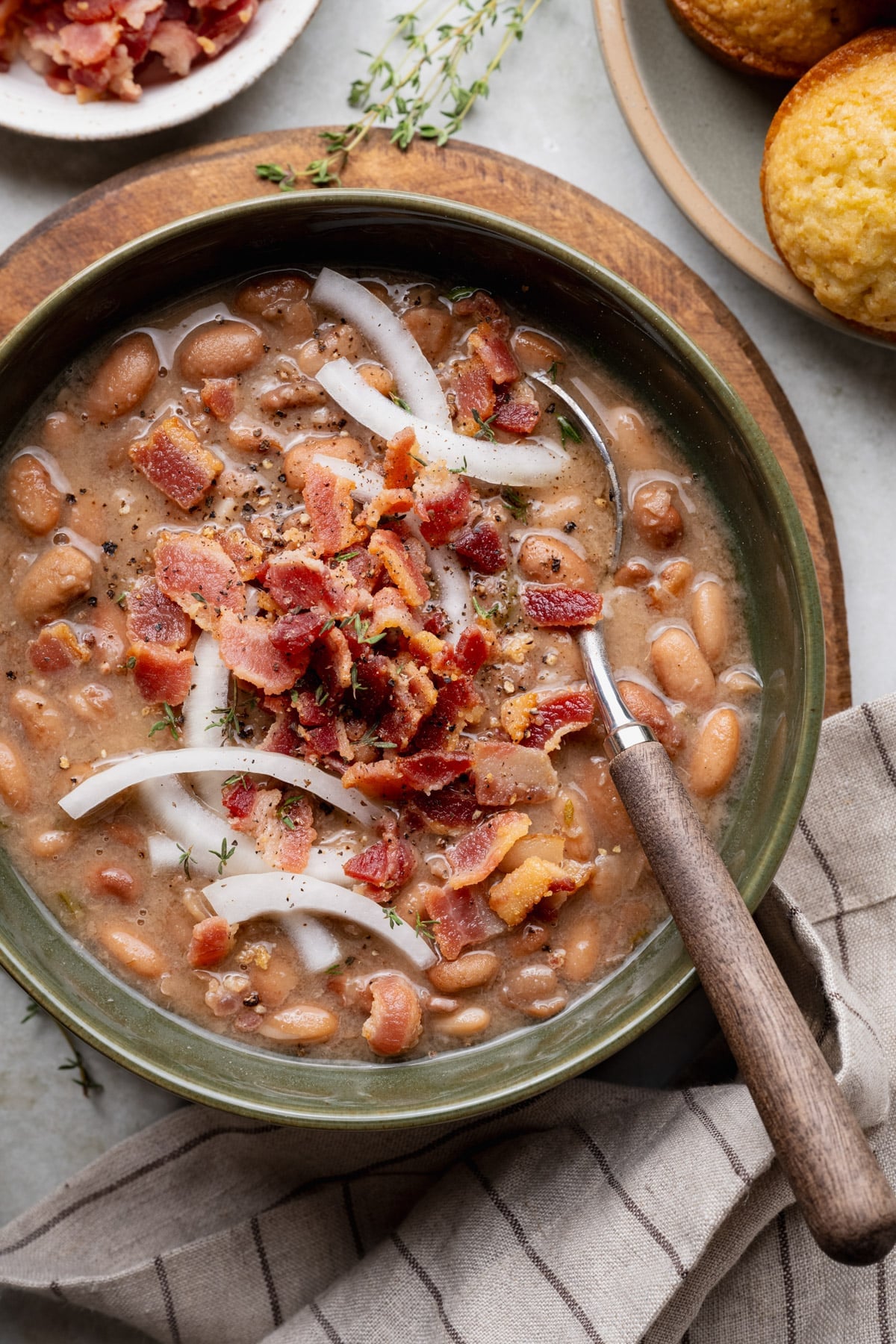
A pound of dried beans and one smoked ham hock feed six to eight people, which makes this one of the most affordable suppers you can put on the table! It’s the kind of cooking that came out of necessity in the mountains and stuck around because it tastes so good.
Before You Get Started
A pot of beans is about as forgiving as cooking gets, but three things separate creamy and tender from tough and bland:
- Soak the beans overnight. Dried beans need the long soak to cook evenly. It also cuts the simmer time and keeps fewer skins from splitting open.
- Wait to add the salt. Ham hocks are already salty, and salting early makes beans take longer to soften. Season near the end, once you can taste it.
- Keep the beans covered in liquid. More water cooks off than you’d expect. Check as you stir and add warm water so the beans stay submerged.
How to Make Soup Beans
Soup beans aren’t quite the same thing as bean soup. Bean soup is brothy, while soup beans cook down thick and creamy from the starch the beans release as they soften. You can make them in a Dutch oven on the stovetop, which is what’s shown here, or in the slow cooker.
Step 1: Soak the Beans
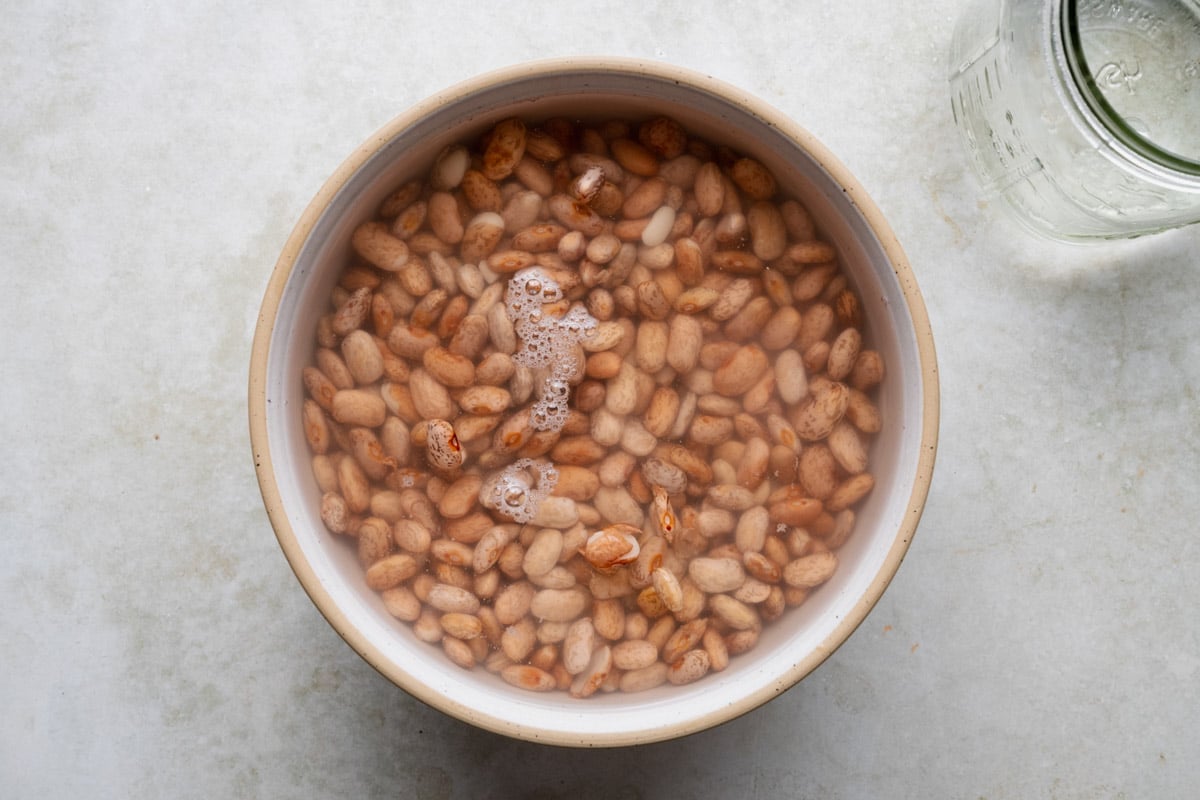
Put the beans in a large bowl or pot and cover them with cold water by about 2 inches. Cover and let them sit overnight, then drain and rinse. They’ll roughly double in size, so give them room.
⇢ Forgot to soak? Quick soak instead. Rinse the beans, cover with cold water in a large pot, and bring to a boil. Boil uncovered for 5 minutes, pull the pot off the heat, and let them sit in the hot water for 1 hour. Drain, rinse, and carry on.
Step 2: Fry the Bacon
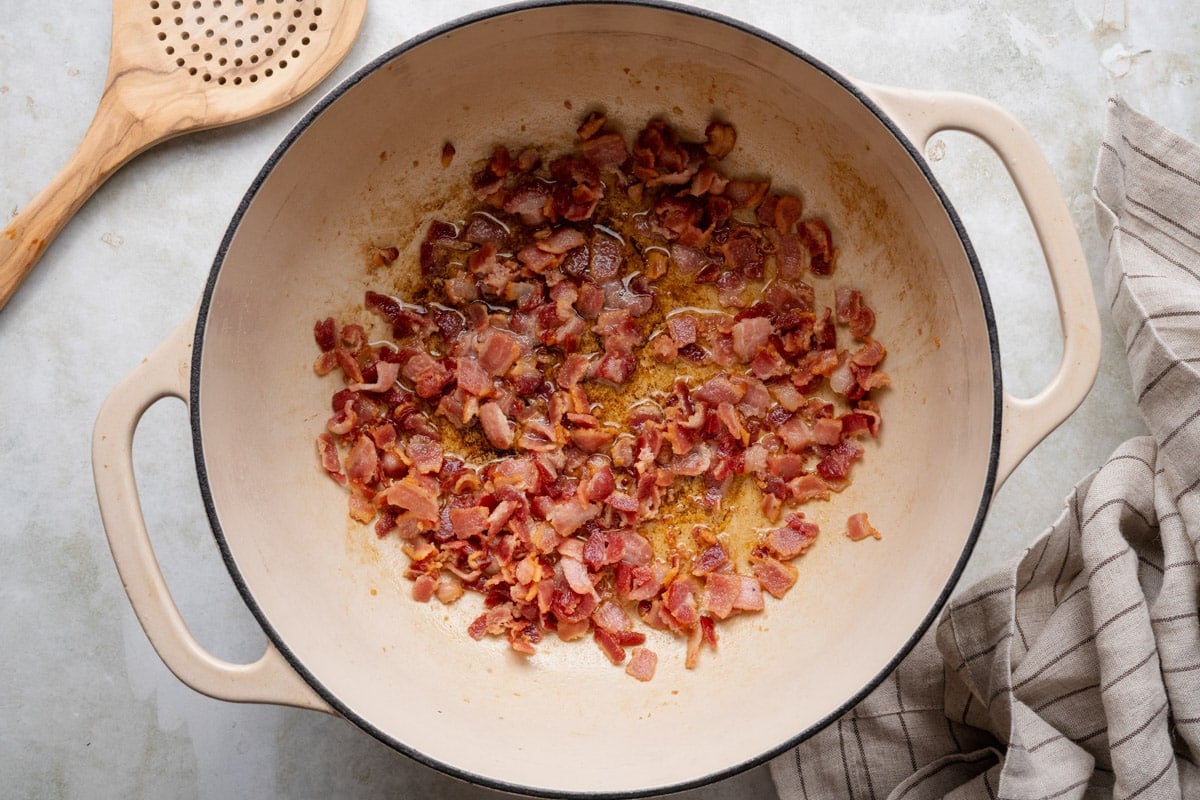
Cook the chopped bacon in a large Dutch oven over medium heat until crisp, about 7 to 8 minutes.
Use a slotted spoon to move it to a paper towel lined plate, and leave about 2 tablespoons of drippings in the pot. Pour off anything beyond that, or the finished beans turn greasy.
The bacon does two jobs here. The drippings build a smoky base for the vegetables, and the crisp pieces go on top at the end.
Step 3: Cook the Vegetables
Add the onion and celery to the drippings and cook over medium-high heat until they start to soften, about 5 minutes. Stir in the garlic and cook 30 seconds more, stirring the whole time so it doesn’t scorch.
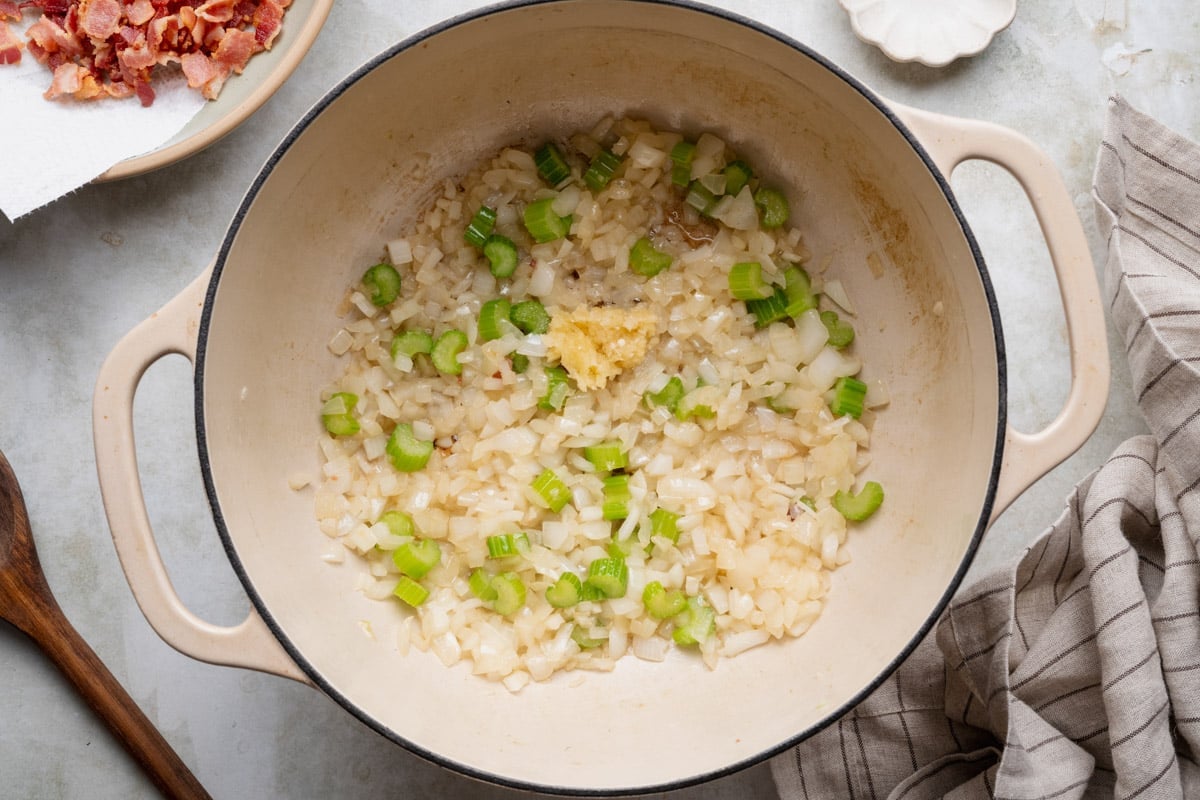
Pour in 1 cup of the broth and scrape the browned bits off the bottom of the pot with a wooden spoon. That’s where a lot of the bacon flavor is hiding, so don’t skip it.

Step 4: Add the Beans and Ham Hock
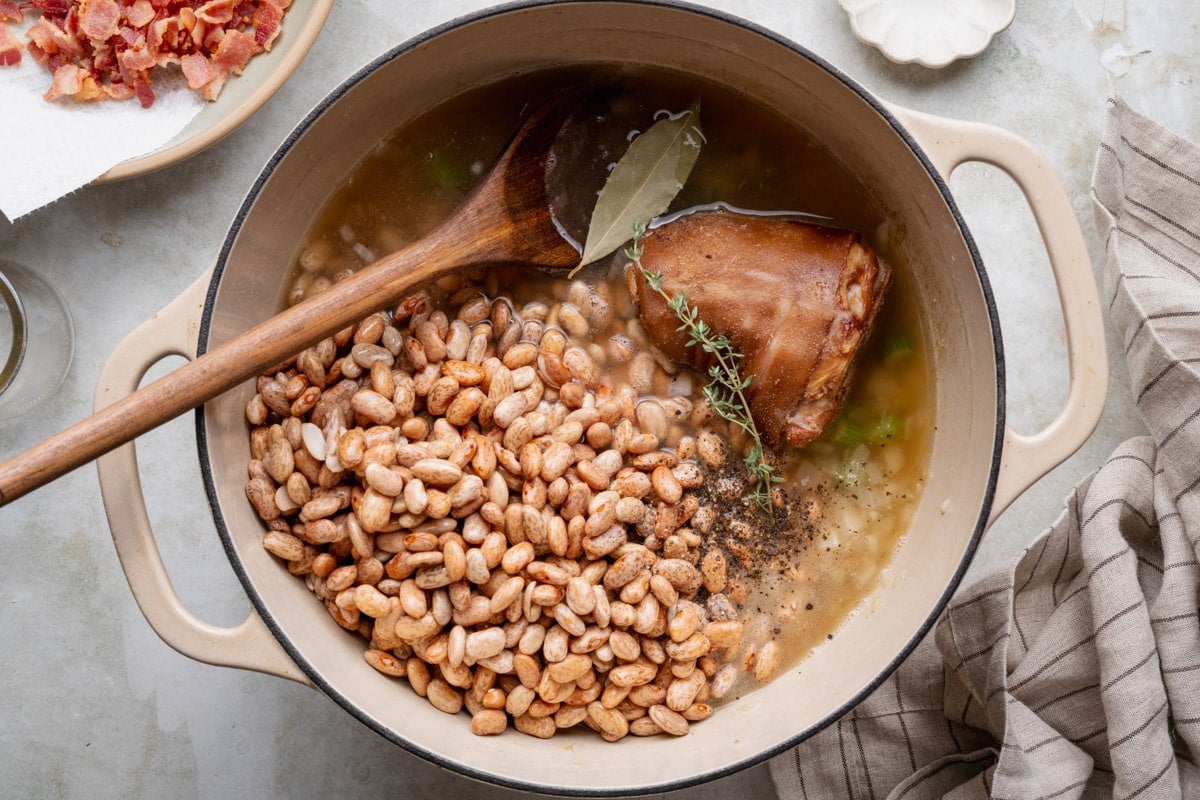
Add the soaked beans, the remaining 3 cups of broth, the ham hock, bay leaf, thyme, and black pepper. Hold off on the salt. Pour in enough cold water to cover everything by about 2 inches and give it a good stir.
The ham hock is doing the heavy lifting on flavor. Over a long simmer it releases smoke, salt, and enough collagen to give the broth real body.
⇢ No ham hock? Use another smoked cut. A smoked ham bone, smoked sausage, smoked turkey wings, or smoked pork neck bones all work. You want something smoked and a little fatty.
Same base, different bean.
My Hoppin’ John starts with this same bacon and ham hock, then finishes with black eyed peas and rice.
Step 5: Simmer Until Tender
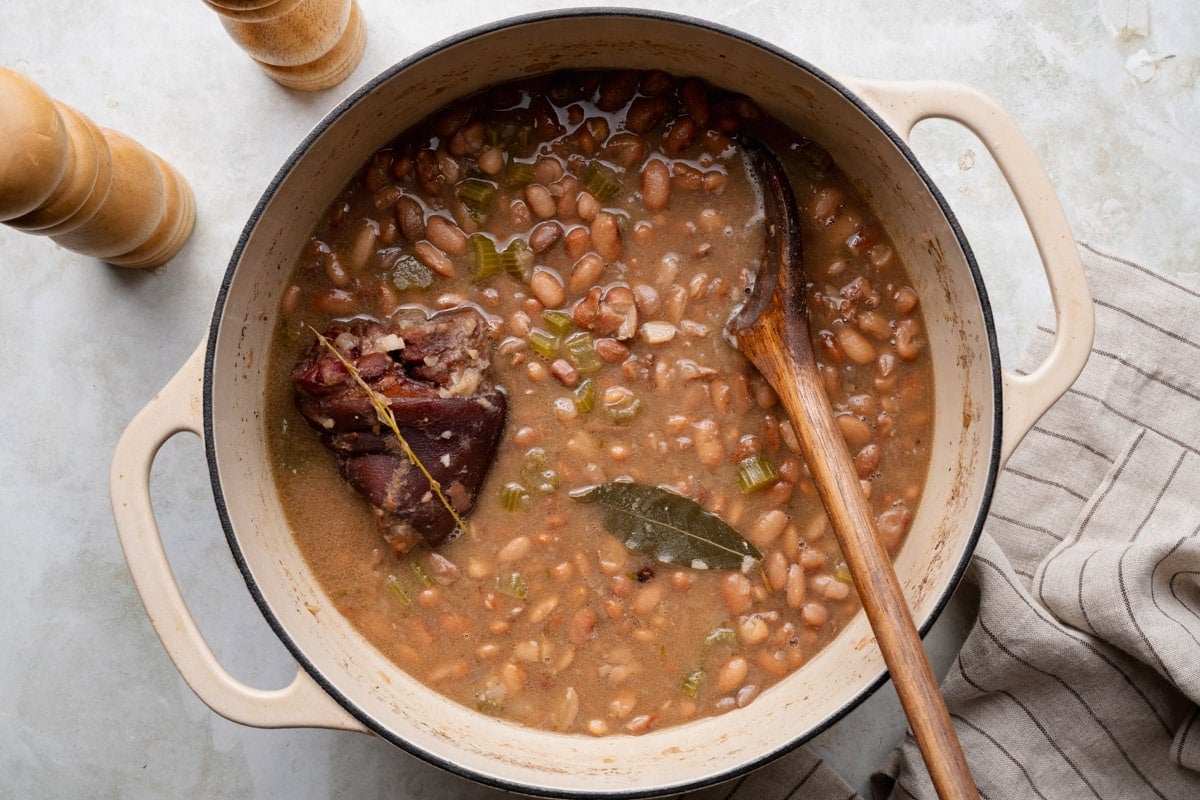
Bring the pot to a boil, then drop the heat to low or medium-low so it’s at a gentle simmer. Partially cover with the lid so some steam escapes, and simmer for about 45 minutes, stirring now and then. Stirring keeps the beans from sticking and helps release the starch that thickens the pot.
Stir in about a teaspoon of salt, then keep simmering for another 30 to 45 minutes until the beans are tender. Check the water level as you go and add more if the beans start to look dry.
Ninety minutes is usually plenty. If you like them really broken down and creamy, let them go longer.
⇢ Make it vegetarian: Skip the bacon and ham hock, sauté the vegetables in olive oil, and use vegetable broth. Add a few drops of liquid smoke, some smoked paprika, or a little cumin to get that smoky depth back.
Step 6: Mash and Season
Fish out the ham hock, bay leaf, and thyme sprig and discard them. If there’s good meat on the hock, pull it off and stir it back in.
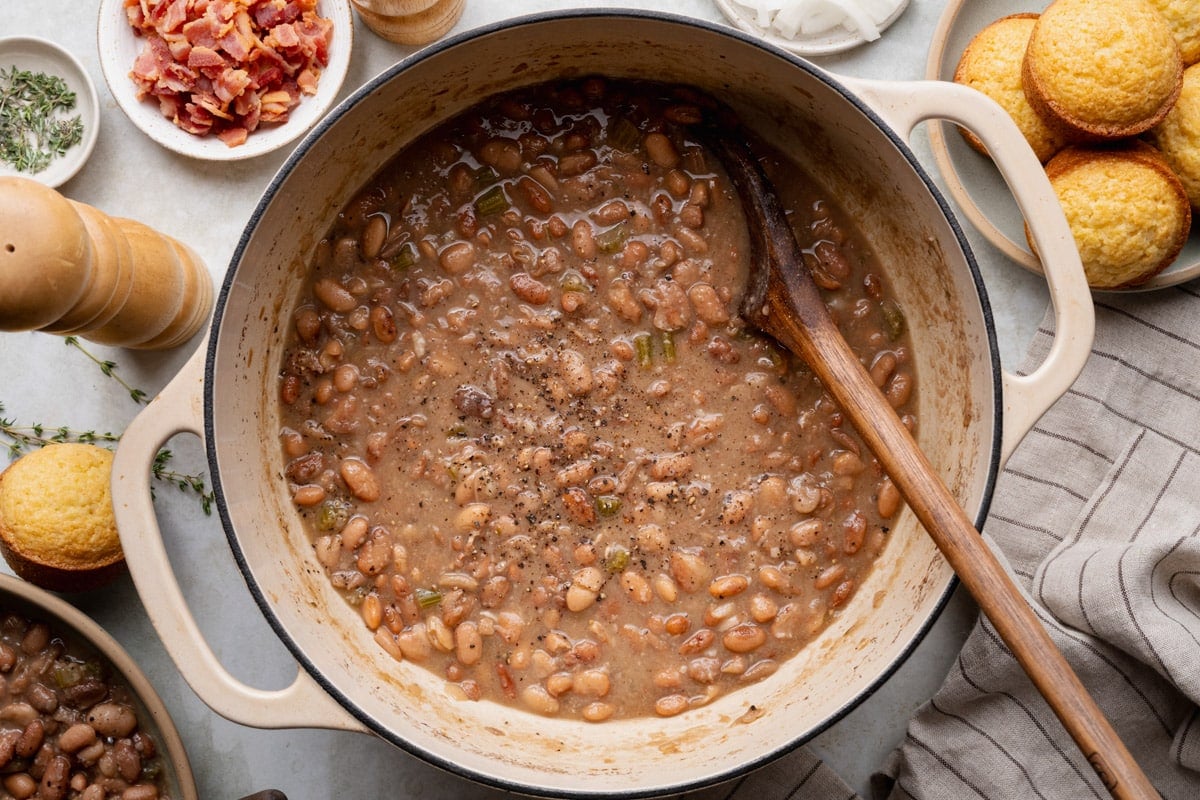
Use the back of a spoon or a potato masher to mash some of the beans against the side of the pot. This is what turns a pot of beans into soup beans, no cream required. Taste, then add more salt and pepper if it needs it.
⇢ Want it thicker? Simmer with the lid all the way off for the last stretch so more liquid evaporates, mash more of the beans, or blitz a portion with an immersion blender.
Step 7: Garnish and Serve
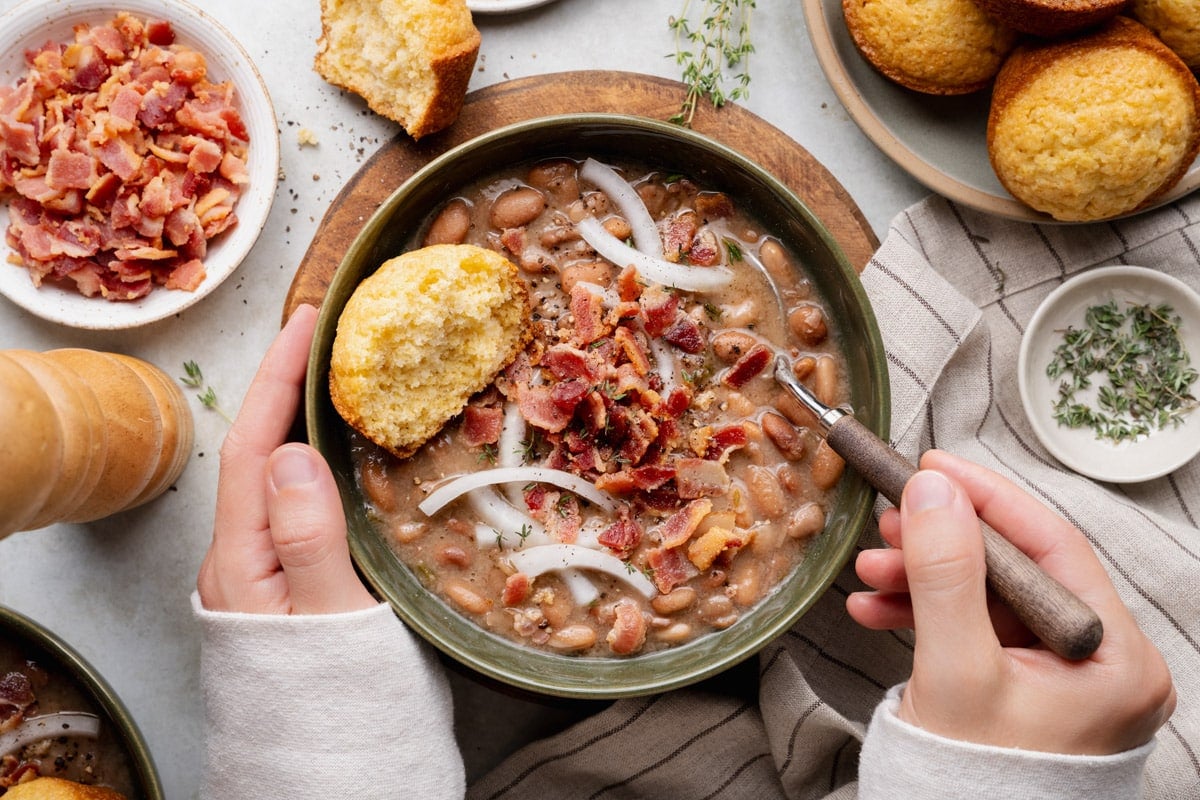
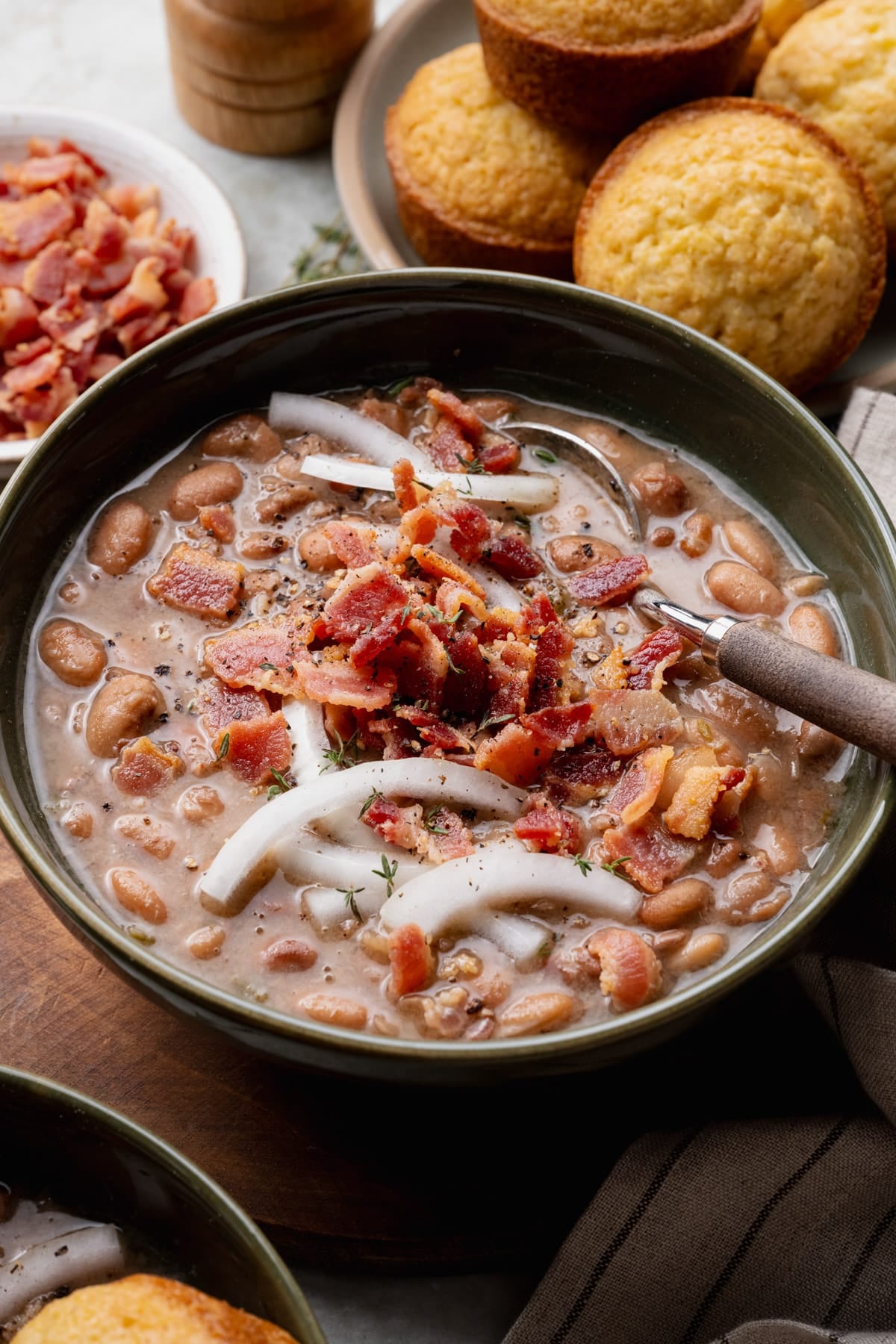
Ladle the beans into bowls and top them. Crispy bacon, chopped raw onion or ramps, and chow chow are traditional, and a dash of hot sauce, a splash of apple cider vinegar, or a squeeze of lemon adds a bright note that cuts the richness.
If you’re not familiar with chow chow, it’s a tangy Southern pickled relish made from cabbage, green tomatoes, and peppers. A spoonful on top of a bowl of beans is about as Appalachian as it gets.
Slow Cooker Option
Soak the beans, fry the bacon, and cook the vegetables exactly as written in steps 1 through 3. Transfer the vegetables and broth to a 6-quart slow cooker, then add the beans, remaining broth, ham hock, bay leaf, thyme, and pepper. Cover with cold water by 2 inches.
Cook on HIGH for 4 to 5 hours or on LOW for 8 to 10 hours, until tender. Season with about a teaspoon of salt during the last hour or two. If you want a thicker pot, take the lid off for the final couple of hours. Finish with steps 6 and 7.
What to Serve with Soup Beans
Cornbread is the best side to pair with this dish! A skillet of cornbread for sopping up the pot likker is most traditional, and it’s what most people picture when they think of soup beans. Jiffy corn muffins with sour cream are worth considering if you like a little sweetness against all that smoke.
From there, a pot of greens and something starchy rounds out the plate the way it’s been done in the mountains for generations.
Storage
Refrigerator: Store leftovers in an airtight container for 3 to 4 days. They’ll thicken as they cool and taste even better the next day, so this is a good one to make ahead.
Freezer: Let the beans cool to room temperature, then freeze in an airtight container for up to 3 months. They freeze beautifully, so a big pot is never wasted.
Reheating: Warm on the stovetop over low heat until heated through, or microwave individual bowls for 1 to 2 minutes. Stir in a splash of broth or water to loosen them back up.
Frequently Asked Questions
Can I use canned beans instead of dried?
Yes, and it’s a good shortcut when you forget to soak. Use four 15-ounce cans of pinto or Great Northern beans, drained and rinsed, and skip straight to frying the bacon. Add the beans with the broth and ham hock, then simmer for about 30 minutes instead of 90.
You lose a little depth, since canned beans don’t soak up the smoky broth the way dried ones do, so give the pot a longer simmer if you have the time.
Why are my beans still hard?
Nine times out of ten the beans are old. Dried beans sitting in the pantry for a year or more can simmer all afternoon and never fully soften, so buy from a store with good turnover. Salting too early does it too, which is why the salt goes in near the end here. Very hard tap water can also slow things down. If your beans are stubborn, keep simmering and add hot water as needed. They’ll usually get there.
Can I use a different bean instead of pinto?
Absolutely. Pintos are traditional, and they’re called brown beans in the mountains, but Great Northern beans, navy beans, butter beans, and black eyed peas all work. Just watch the timing, since smaller white beans and black eyed peas cook faster than pintos and can turn to mush if you walk away. Start checking those about 20 minutes early.
Do I need both the bacon and the ham hock?
They’re doing different jobs, so I’d keep both if you can. The bacon gives you drippings to cook the vegetables in and a crisp garnish at the end, while the ham hock delivers the deep smoky flavor and the body that makes the broth feel rich. If you only have one, go with the ham hock. You can sauté the vegetables in olive oil and still end up with a great pot of beans.
More Southern Bean and Ham Recipes

Did you make this recipe?
If you enjoyed this recipe, please leave a comment with a 5-star review at the bottom of the post. Thank you!

Appalachian Soup Beans {Pinto Bean Soup}
Ingredients
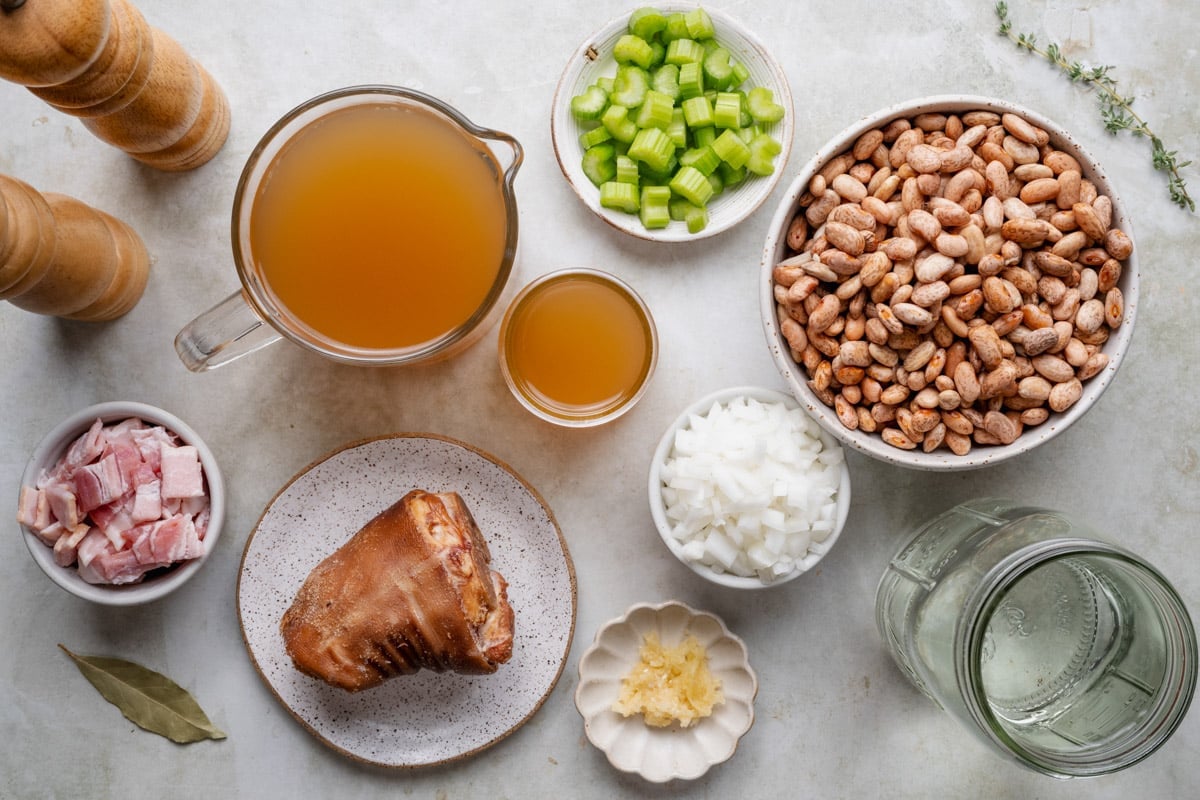
- 1 lb. dried pinto beans
- Cold water, for soaking and cooking
- ½ lb. bacon (about 7 to 8 strips), chopped
- 1 large onion, chopped
- 1 stalk celery, chopped
- 4 cloves garlic, minced or grated
- 4 cups low-sodium chicken broth, divided
- 1 smoked ham hock (about 10 to 12 ounces)
- 1 dried bay leaf
- 1 fresh thyme sprig (or about ½ teaspoon dried thyme)
- Kosher salt and ground black pepper, to taste
- Optional, for serving: chopped fresh herbs (such as thyme), chopped raw onion or ramps, chow-chow, cornbread
Instructions
Stovetop Method
- Soak the beans: Place the beans in a large bowl or pot and cover with cold water by 2 inches. Cover and let stand overnight. Drain and rinse.

- Fry the bacon: In a large Dutch oven over medium heat, cook the bacon until crisp, about 7 to 8 minutes. Use a slotted spoon to remove it to a paper towel lined plate. Reserve 2 tablespoons of drippings in the pot and discard the rest.

- Cook the vegetables: Add the onion and celery to the drippings. Cook over medium-high heat until they start to soften, about 5 minutes. Add the garlic and cook 30 seconds more, stirring constantly.

- Deglaze the pot: Stir in 1 cup of the chicken broth and use a wooden spoon to scrape up the browned bits from the bottom.

- Add the beans: Add the beans, remaining 3 cups of broth, ham hock, bay leaf, thyme, and black pepper to taste. Do not add salt yet. Pour in enough cold water to cover the beans by about 2 inches and stir well.

- Simmer: Bring to a boil, then reduce the heat to low or medium-low for a gentle simmer. Partially cover and simmer for about 45 minutes, stirring occasionally. Add more water if the beans start to look dry.

- Season and finish cooking: Stir in about 1 teaspoon of salt. Continue simmering for 30 to 45 more minutes, until the beans are tender.

- Mash and season: Discard the ham hock, bay leaf, and thyme sprig. Use the back of a spoon or a potato masher to mash some of the beans, thickening the broth. Taste and adjust the salt and pepper.

- Serve: Ladle into bowls. Garnish with the crispy bacon, chow chow, herbs, and chopped onion. Serve with cornbread.

Slow Cooker Method
- Soak the beans: Place the beans in a large bowl or pot and cover with cold water by 2 inches. Cover and let stand overnight. Drain and rinse.
- Fry the bacon: In a large skillet or Dutch oven over medium heat, cook the bacon until crisp, about 7 to 8 minutes. Remove to a paper towel lined plate and reserve 2 tablespoons of drippings.
- Cook the vegetables: Add the onion and celery to the drippings. Cook over medium-high heat about 5 minutes, until softened. Add the garlic and cook 30 seconds more. Stir in 1 cup of the broth, scraping up the browned bits.
- Transfer to the slow cooker: Pour the onion and broth mixture into a 6-quart slow cooker.
- Add the beans: Add the beans, remaining 3 cups of broth, ham hock, bay leaf, thyme, and black pepper to taste. Do not add salt yet. Cover with cold water by about 2 inches and stir well.
- Cook: Cover and cook on HIGH for 4 to 5 hours or on LOW for 8 to 10 hours, until tender. Season with about 1 teaspoon of salt during the final 1 to 2 hours. Remove the lid for the last couple of hours if you'd like a thicker pot.
- Mash and serve: Discard the ham hock, bay leaf, and thyme sprig. Mash some of the beans to thicken the broth. Taste and adjust seasoning, then ladle into bowls and garnish.
Notes
- Salt timing: Wait until the last stretch of cooking to salt the pot. Ham hocks are already salty, and salting early makes the beans take longer to soften.
- Water level: The amount of water you need varies with how hard the pot simmers. Check as you stir and add more so the beans stay covered.
- Texture: Ninety minutes is enough to soften the beans. Cook them longer if you like them really broken down and creamy.
- Canned bean shortcut: Use four 15-ounce cans of pinto or Great Northern beans, drained and rinsed, and skip the soak. Add them with the broth and simmer about 30 minutes instead of 90.
- Bean swaps: Great Northern beans, navy beans, butter beans, and black eyed peas all work. Smaller beans cook faster, so start checking about 20 minutes early.
- Other smoked meats: No ham hock? Use a smoked ham bone, smoked sausage, smoked turkey wings, or smoked pork neck bones.
- Vegetarian version: Omit the bacon and ham hock, sauté the vegetables in olive oil, and use vegetable broth. Add liquid smoke, smoked paprika, or a little cumin for smoky depth.
- Make ahead and storage: Refrigerate up to 4 days or freeze up to 3 months. The beans thicken as they cool, so add a splash of broth or water when reheating.
- Recipe adapted from Taste of the South magazine.
Nutrition
Originally published in September, 2022, this post was updated in October, 2026.













Ooh, Blair! Now you’re talking. I’ll definitely try this. You may remember that I’m from West Virginia originally, as were my parents. In the winter, my mother used to make soupy beans with just navy beans, salt pork and onions in her pressure cooker. When the beans were dished up she always had some extra chopped onion and salt and pepper so everyone could season as they liked. It was very plain but really good. I will testify that tje beans were much softer, like a porridge with a little broth. She always served the beans with corn pone, cole slaw and carrot sticks. That menu was set in stone. I suspect the bean soup and menu started with my grandma, mother’s mother. Maybe from a ww 2 rationing cookbook.
I will try to find the recipe for the corn pone for you. Grandma was also well known for her hot water gingerbread which I will also try to find so I can share it with you.
Thank you for all you do, AGAIN! Take care and lots of love to all!
Sounds like good, down-home cooking, Marion! I would LOVE your corn pone and gingerbread recipes! Thank you. 🙂
Also, yes — if you prefer the beans more broken down and soft, that’s no problem…just cook them longer. Easy comfort food!
I’ve made this recipe twice now. The first time I made it, I failed to get/prep the beans so I just used 4 cans of great Northern beans and went right to step 2. DELICIOUS! It’s on the stove now, also using the canned beans because this time I was just lazy . Can’t wait! Thank you!
Thanks, Laura! I’m so glad to hear that you enjoy it — whether you make it with dried or canned beans! 🙂
I mean the beans were much softer the next day.
It’s quite true any bean softens up the longer it cooks. I guess what I meant was just a heads up that my mother’s bean soup, became more like a porridge after sitting overnight. I was happy to eat it in any form but I know some people have definite preferences concerning textures.
Got it! Yes, true!
Good morning Blair,
A little Fall in the air makes one think of warm and comforting dishes. Most any variety of bean cooked in this manner is delicious. A lesson learned from a WW1 mess cook who wasted no food mixed the bean leftovers with cornmeal , egg, baking powder, salt and the pot likker for liquid. These were griddled like Scottish scones and eaten for breakfast with cane syrup and breakfast meat. Also packed well for lunch.
Enjoy your site, recipes and the comments are sometimes comical to someone who has been cooking and a farmer/ cattleman’s wife for 56 years.
That’s a great tip, Sharon. Thank you! I’m sure that you have many tricks up your sleeve if you’ve been in the kitchen for almost 60 years. That’s amazing!
Thank you for this recipe; it’s perfect! The directions are very clear and the soup beans turned out great. I trimmed any pieces of lean ham hock and added it to the soup. For individual servings I use different combinations of vinegar, hot sauce, bacon bits, liquid smoke, jalapeño relish, cooked collards and Lil’ Smokies to get different flavors. The soup beans are good as is or with just about anything else you might want to add. The fist batch is gone and I will make it again.
Thank you, Al! I’m so glad that you like them!
I’m always trying recipes from the Internet. this time I found a winner. This recipe is so delicious.
Thank you! We’re so glad you found ours and enjoyed it.