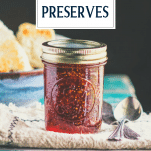
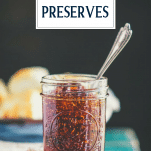
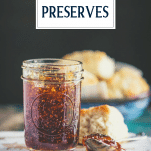
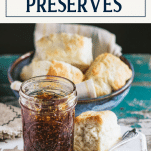
These old-fashioned fig preserves require just 3 ingredients — and no pectin! One of the easiest jams to make, there’s very little prep work necessary. Just simmer a pot on the stove for a couple of hours and you’ll have a few jars of beautiful, preserved fresh figs to enjoy with cheese on your next charcuterie board, to spread on biscuits, cornbread, or toast, to elevate sandwiches, or to use in baked goods like cakes.
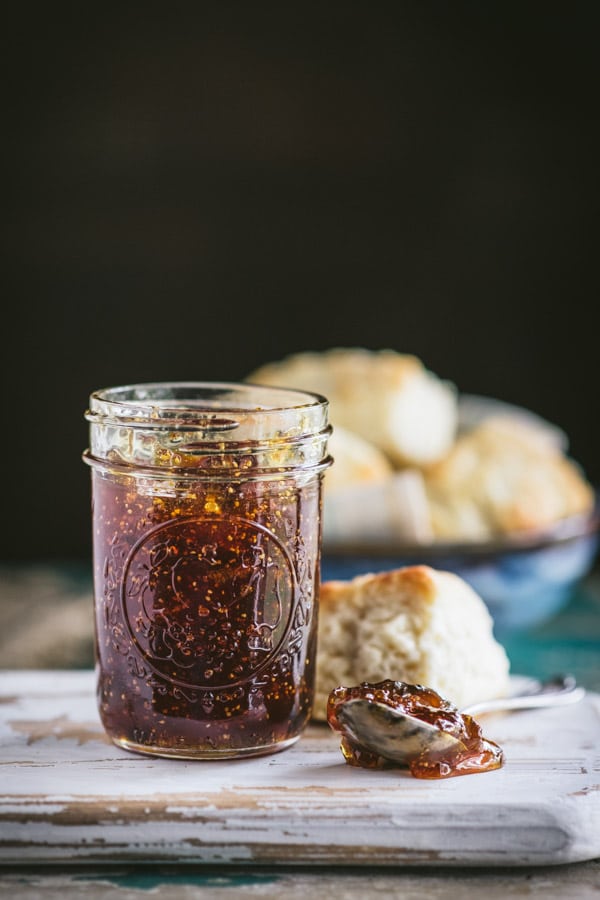
Table of Contents
Figs generally ripen twice a year: the first or “breba” season is typically in early June, while the second or “new wood” season generally runs from August through October. When my neighbor’s Brown Turkey figs ripened early this year (thanks to a warm winter in Virginia), she was happy to share some with us. There’s no better way to enjoy a bunch of figs than turning them into fig preserves!
Old Fashioned Fig Preserves
This is a standard, old-fashioned fig preserves recipe, which includes equal amounts of both figs and sugar. It’s easy to scale up or down, depending on how many figs you have, or how many jars you plan to make. The thinly-sliced lemon is another classic ingredient, which adds acidic brightness to balance out the sweetness of the figs.
I’ve included instructions for canning fig preserves below, but you can also skip the step of processing the jars in a hot water bath and just store the preserves in the refrigerator if you prefer.
Fig Preserves vs. Fig Jam
Fig preserves are not technically the same as fig jam, although this particular recipe yields a jar of preserves that’s quite similar to jam. In general, jam is made with mashed fruit while preserves have whole fruit or large pieces of fruit throughout.
This whole fig preserves recipe starts with the whole fruit (just the stems removed). You don’t need to chop, peel, mash, or process the figs before adding them to the pot.
As the figs cook, soften, and break down, I like to use my wooden spoon to break apart some of the larger pieces of fruit. In the end, you have a chunky fig spread that actually resembles jam more than preserves. If you prefer whole fig preserves with large chunks or the fruit intact, that’s fine…just don’t break them apart as much when you’re stirring the pot.
Ingredients
This is an overview of the ingredients that you’ll need for an old fashioned fig preserves recipe without pectin. As always, specific measurements and complete cooking instructions are included in the printable recipe box at the bottom of the post.
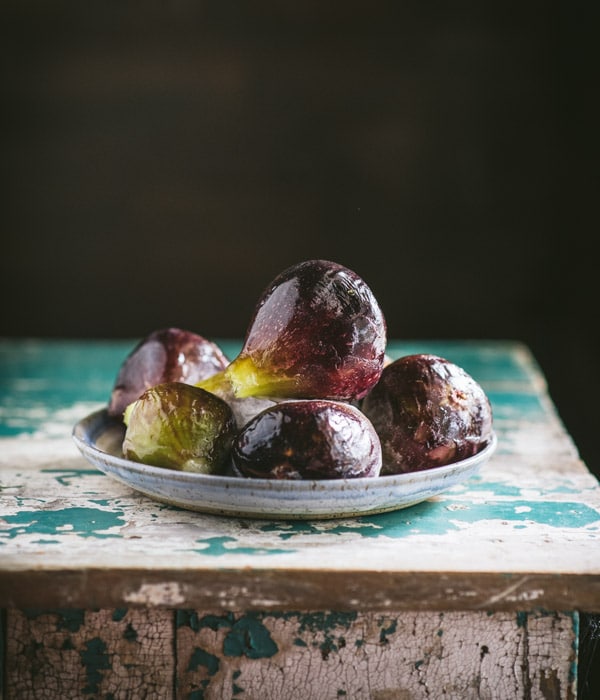
- Fresh figs: I use Brown Turkey figs, but you can use Black Mission figs or just about any other fresh figs available.
- Granulated sugar: this classic Southern recipe calls for an equal amount of sugar and figs; however, you can see my note below to adjust the recipe for less sugar.
- Lemon: gives the spread a bright, acidic note that balances the sweetness of the figs and helps to make the preserves safe for shelf-stable canning.
Equipment Needed
- 3 sterilized half-pint mason jars and lids: this recipe yields enough for about 3 (8-ounce) jars of jam. I like the half-pint jars because it’s just the right amount of jam to keep in the fridge after it’s opened, but smaller 4-ounce jars are also a great option.
- A sterilized funnel: this makes it easier to get the jam inside the jar without spilling; however, it’s fine if you don’t have a funnel — you can carefully spoon the jam into the jars instead.
- Tongs: canning tongs are incredibly helpful when taking the jars in and out of the boiling water.
- Stock pot, saucepan, or Dutch oven: for cooking the preserves.
- Canner or large pot for boiling jars: this needs to be very deep so that you can cover the jars with at least 1-2 inches of water. I use my deepest stock pot for this step, since I don’t have an official canner to process the jars.
- Wooden spoon: to stir, stir, stir so that the jam doesn’t stick to the pot!
How to Sterilize Jars and Lids for Jam or Preserves
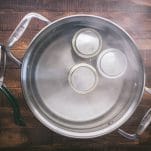
It’s a good practice to sterilize the jars and lids before canning in order to kill any bacteria, fungi or yeast. There are a variety of ways to sterilize the jars (here’s a helpful article with different options). I typically use the dishwasher, or just boil them for 10 minutes in the same big pot of water that I’ll use for processing.
How to Make Fig Preserves
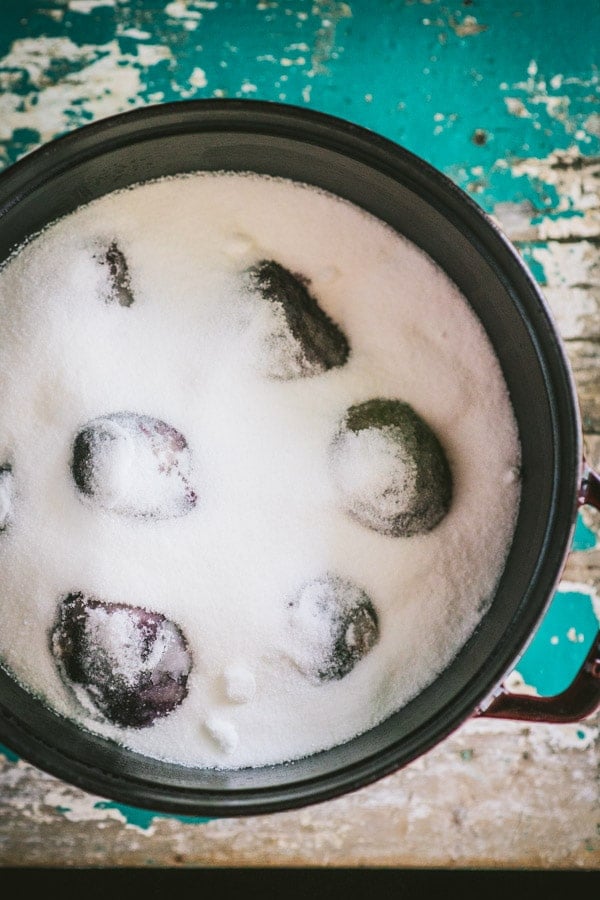
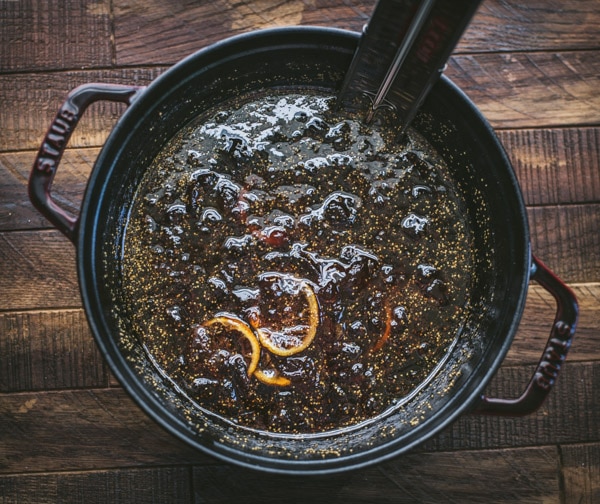
This recipe is incredibly simple — no peeling, mashing, or chopping necessary! Just remember to plan ahead and let the figs sit in the sugar overnight. The fruit will release juices as it sits, and you won’t need to add any water to the pot in the morning.
I’ve included the detailed directions in the recipe card below, but here’s the quick overview:
- Cut off the stems from the figs.
- Place figs in a large pot or Dutch oven and cover with sugar.
- Cover the pot and let the figs sit in the sugar overnight.
- Heat the pot on the stovetop over medium heat. Cook, stirring constantly, until the sugar dissolves (this only takes a few minutes).
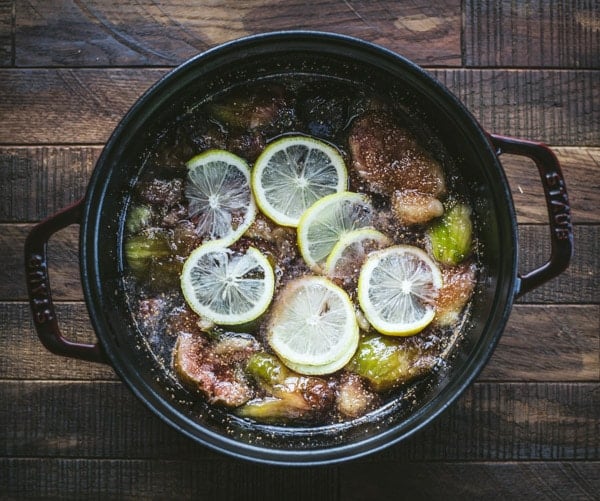
- Reduce the heat to low, add the lemon slices, and cook for about 2 hours.
- Divide the figs and syrup between sterilized jars. Wipe rims clean with paper towels, then secure lids and rings.

How to Thicken Fig Preserves
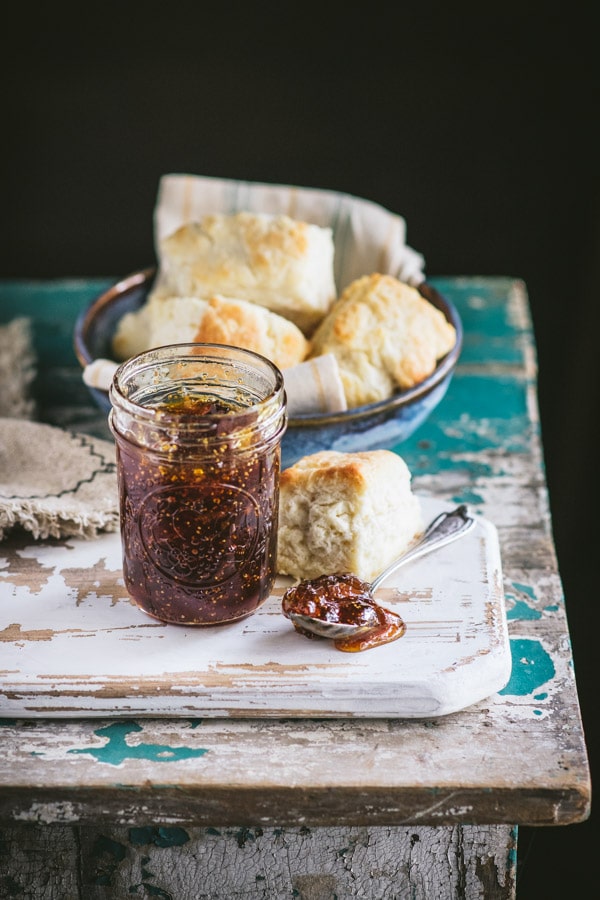
You don’t need added pectin to thicken this fig preserve recipe. Instead, the slow cooking process allows the figs and sugar to naturally thicken on their own.
The longer you simmer the pot, the thicker the jam will be. This typically takes about 2 hours, but it might be a bit less or a bit more. As a result, I find that it’s most helpful to use a candy or deep-fry thermometer to know exactly when the mixture reaches the jelling point of 220-225°F.
It’s important that you don’t cook the preserves for too long, or the mixture will be too thick to spread once it cools.
Canning Fig Preserves
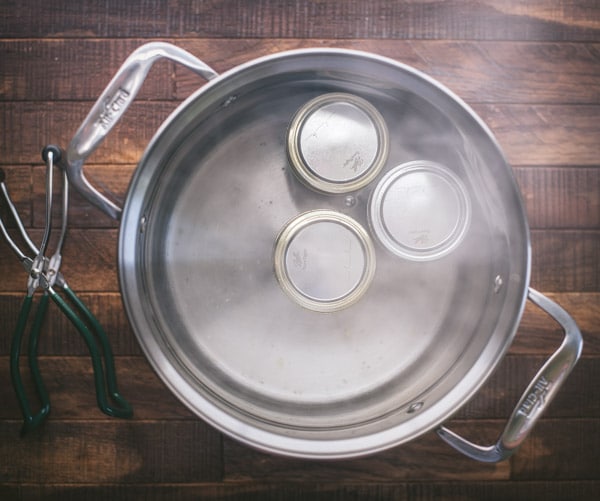
Once the sterilized jars are full and sealed, set the hot jars on a rack in a canner or in a large pot of boiling water. Make sure that the pot is deep enough so that the jars are covered by at least 1-2 inches of boiling water. Boil for 10 minutes (or 15 minutes if your altitude is above 6,000 feet).
How long does it take for easy fig preserves to set?
Once the jars are filled and processed in the hot water bath for 10 minutes, place the jars on a dish towel on the counter. The jam will not set immediately, so it’s important to allow the jars to rest without interruption at room temperature until cool (or overnight), about 12 hours. Don’t forget that the preserves will continue to thicken as they cool and set.
Storage
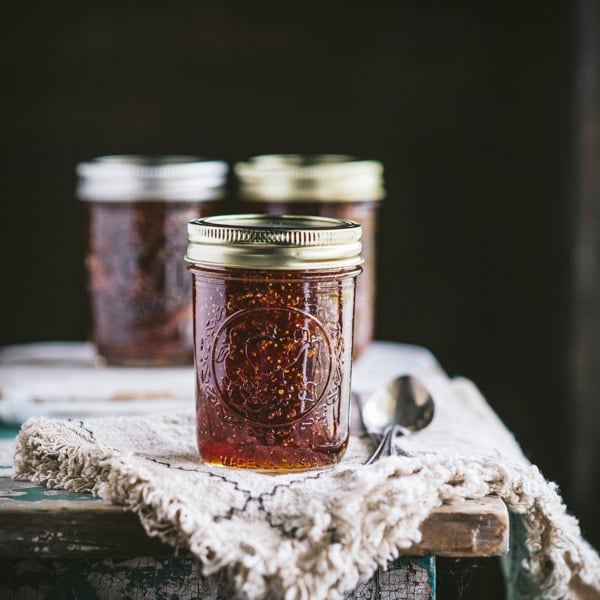
Once the jam has had a chance to cool, you can check the seals on your jars. The lids should be down in the center or stay down when pressed. Unsealed jars should be refrigerated and used within 3 weeks. Properly sealed and processed jars of fig preserves should be stored in a cool, dark, dry place (such as a pantry) for up to 8 months.
If you choose not to process your jars of preserves in a hot water bath, they need to be stored in the refrigerator. These jars will stay fresh for up to 3 weeks. To freeze unprocessed jars of preserves, be sure to leave about 1-inch of headspace at the top of each jar to allow for expansion.
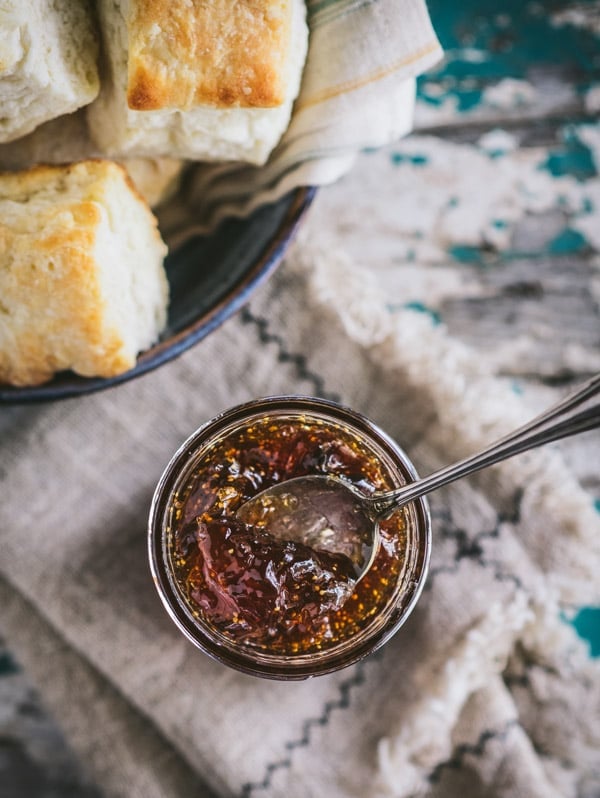
What do you eat fig preserves with?
This versatile fig spread is delicious in a variety of dishes. Try serving the preserves:
- Spread on flaky biscuits, 7up biscuits, cornbread, sour cream muffins, or toast.
- On a cheese plate at your next cocktail hour.
- On top of brie cheese.
- Stirred into oatmeal for breakfast.
- Over vanilla ice cream for dessert.
- On sandwiches for a sweet contrast to smoked turkey, country ham, roast beef or Swiss cheese.
- In baked goods such as cakes and bars.
Fig Preserves Recipe Variations
- Less sugar. While many old time fig preserves recipes call for equal parts figs and sugar, some folks prefer a less-sweet jar of preserves. Feel free to play around with the ratio and reduce the amount of sugar in your pot to suit your taste preferences — especially if the figs that you’re using are already very sweet on their own.
- Fig preserves without lemon. The lemon adds a nice acidic balance to the sweet figs, and gives the spread a marmalade-like taste. It’s also an important ingredient if you want your preserves to be shelf-stable. If you’re just planning to refrigerate your preserves for up to 1 month (and skip the hot water bath), then you can omit the lemons if you like.
- This recipe yields a small batch of just 3 jars; however, you can scale the recipe to make a larger batch. If you have a bunch of figs available, just multiply all of the ingredients to create more preserves. For instance, use 3 lbs. of figs, 3 lbs. of sugar and 1 whole lemon.
- If you don’t want to bother with canning the jars in a water bath, no problem! Just transfer the jam to jars, let them cool completely at room temperature, and then store in the refrigerator for up to 3 weeks.
- I used Brown Turkey figs here, but you can substitute with Black Mission figs or just about any other fresh figs available.
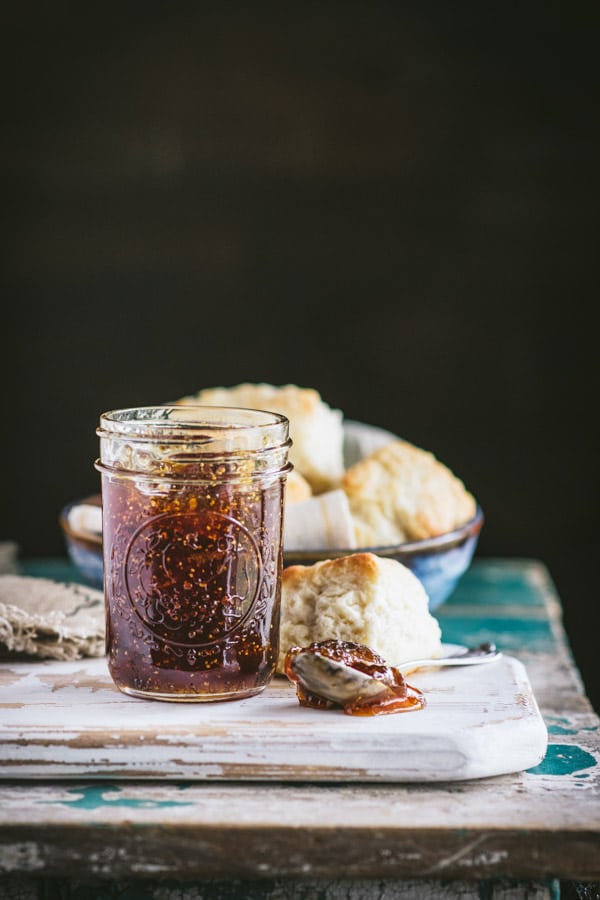
Tips for the Best Fig Preserves Recipe
- Do not overcook the preserves or the mixture will become too thick to spread. The preserves thicken significantly as they cool and set, so don’t worry if the syrup still looks fairly thin at the end. The total cooking time may vary — in some instances you might need less than 2 hours, in some instances more. This is why I find a candy thermometer to be so helpful — you’ll know exactly when it reaches the jelling point of 220-225° F.
- If possible, weigh your fruit after trimming the stems. This will give you a more accurate measurement to make sure that you have the correct amount of fruit. For instance, I started with about 1 ¾ lbs. of fresh figs before trimming, which left me with 1 ½ lbs. of fruit to use in the recipe.
- Slice the lemon paper-thin before adding it to the pot. This way you’ll end up with bits of lemon throughout, but you won’t have any big chunks to bite into.
- Use a wooden spoon to break up the large figs as they cook if you prefer a jam-like consistency. For whole fig preserves, leave the figs intact (they will still be soft and spreadable).
- Leave ¼-inch of headspace in each jar. The proper amount of headspace is important to ensure a vacuum seal. If there’s too little headspace, the preserves may expand and bubble out when air is being forced out from under the lid during processing.
More Homemade Jam Recipes to Try

Blackberry Jam (without Pectin)
12 hours hrs 55 minutes mins

Spiced Apple Pear Jam
45 minutes mins

Blueberry Jam without Pectin
12 hours hrs 55 minutes mins

Did you make this recipe?
If you enjoyed this recipe, please leave a comment with a 5-star review at the bottom of the post. Thank you!
Fig Preserves Recipe without Pectin
Equipment
Ingredients
- 1 ½ lbs. fresh figs, stems removed
- 1 ½ lbs. granulated sugar (approximately 3 ¼ cups)
- ½ of a lemon, sliced paper-thin and seeds removed
Instructions
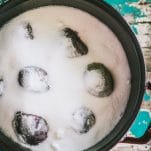
- Place the figs in a large pot. Pour the sugar over the figs, cover the pot, and let sit overnight.
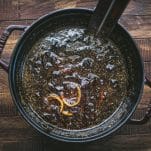
- Heat the pot on the stovetop over medium heat. Cook, stirring constantly, until the sugar dissolves (this only takes a few minutes). Reduce the heat to low, add the lemon slices, and cook for about 2 hours (or until the syrup is thick). If the figs are particularly large, I like to use a wooden spoon or a potato masher to gently break apart the big chunks as the figs soften. If you have a deep fry or candy thermometer, you’re looking for a jelling point of 220-225°F.
- Divide the figs and syrup between 3 sterilized 8-ounce glass jars, leaving ¼-inch of headspace at the top of each jar. Wipe the rims clean with a damp cloth, then secure the lids and bands.
- Process in a boiling water bath for 10 minutes (or 15 minutes if your altitude is above 6,000 feet). Carefully remove the jars to a towel on the counter. Let stand, undisturbed, for 12 hours at room temperature. Check the seals after 12 hours by pressing the center of the lids. If the lid gives or the center button remains popped up, store in the refrigerator for up to 1 month. Properly sealed jars will keep in a cool, dark place for up to 8 months. Refrigerate after opening.
Notes
- Less sugar. While many old time fig preserves recipes call for equal parts figs and sugar, some folks prefer a less-sweet jar of preserves. Feel free to play around with the ratio and reduce the amount of sugar in your pot to suit your taste preferences — especially if the figs that you’re using are already very sweet on their own.
- Fig preserves without lemon. The lemon adds a nice acidic balance to the sweet figs, and gives the spread a marmalade-like taste. It’s also an important ingredient if you want your preserves to be shelf-stable. If you’re just planning to refrigerate your preserves for up to 1 month (and skip the hot water bath), then you can omit the lemons if you like.
- Scale the recipe to make a larger batch. If you have a bunch of figs available, just multiply all of the ingredients to create more preserves. For instance, use 3 lbs. of figs, 3 lbs. of sugar and 1 whole lemon.
- If you don’t want to bother with canning the jars in a water bath, no problem! Just transfer the jam to jars, let them cool completely at room temperature, and then store in the refrigerator for up to 3 weeks.
- I used Brown Turkey figs here, but you can substitute with Black Mission figs or just about any other fresh figs available.
- Do not overcook the preserves or the mixture will become too thick to spread. The preserves thicken up significantly as they cool and set, so don’t worry if the syrup still looks fairly thin at the end. The total cooking time may vary — in some instances you might need less than 2 hours, in some instances more. This is why I find a candy thermometer to be so helpful — you’ll know exactly when it reaches the jelling point of 220-225° F.
- If possible, weigh your fruit after trimming the stems. This will give you a more accurate measurement to make sure that you have the correct amount of fruit. For instance, I started with about 1 ¾ lbs. of fresh figs before trimming, which left me with 1 ½ lbs. of fruit to use in the recipe.
- Slice the lemon paper-thin before adding it to the pot. This way you’ll end up with bits of lemon throughout, but you won’t have any big chunks to bite into.
- Use a wooden spoon to break up the large figs as they cook if you prefer a jam-like consistency. For whole fig preserves, leave the figs intact (they will still be soft and spreadable).
- Leave ¼-inch of headspace in each jar. The proper amount of headspace is important to ensure a vacuum seal. If there’s too little headspace, the preserves may expand and bubble out when air is being forced out from under the lid during processing.
- Recipe adapted from Jan Karon’s Mitford Cookbook & Kitchen Reader.









Delicious recipe! Thank you. I’m not going through the canning process. Will these freeze well, and for how long? Thank you.
Thank you! Yes, to freeze unprocessed jars of preserves, be sure to leave about 1-inch of headspace at the top of each jar to allow for expansion. They will stay fresh for about 6 months.
Just finished a small batch of fig preserves.
Directions are a bit unclear on the lemons.
Commentary indicates lemon is part of the finished product. Directions say to lay slices on top before the two hour cook time.
At what stage are the lemons incorporated into the preserves?
I pulled most of mine out before the jarring. My preserves turned out fine.
Hi, Butch! You add the lemon slices as indicated in Step 2, and then they just stay in the pot and cook for a couple of hours with the preserves. I don’t ever remove them — they go right into the jars with the figs and syrup. Sorry for any confusion, but I hope they turned out well for you!
Hi there,
I am concerned about the large pieces of fig skin that remains as I get close to the desired temperature. Is this normal in fig preserves? I am imagining you would get a large piece of skin when you put your knife in for some to spread?
This is also my first time making something like this. I have a couple fig trees and really want to find a way to utilize them!
Hi Haley,
It’s normal to have pieces of skin. You can always remove or discard them if you aren’t a fan. We hope you enjoy!
So, I ended up cooking for just over 3 hours. At about 2.5 I covered the pot and it finally started getting to the desired temperature. They all sealed well, but are VERY runny, not spreadable at all….what could ahve went wrong? I followed the directions exactly. I do have a class stovetop…?
Thanks, I’m super bummed. I used almost 11 pounds of figs.
Hi Haley,
We’re sorry to hear this! There could be several factors:
1. Water content in the figs
Some figs are juicier than others. If your figs were especially ripe or overripe, they may have released much more liquid, making it harder to get a thick consistency.
2. Cooking vessel & stovetop type
A glass (ceramic) stovetop often runs cooler than gas or exposed-coil electric, and heat transfer can be slower—especially with a heavy pot. If the mixture never reached a rapid boil for long periods, water evaporation would be slower, and thickening would take much longer.
3. Batch size
Scaling up to 11 pounds of figs means you have a lot more liquid to evaporate. Even if you followed ingredient ratios exactly, bigger batches take much longer to reduce—sometimes double or triple the time—because surface area-to-volume ratio is smaller.
Omg, this turned out so good!! A friend gave me a small bag of celeste figs, so I used your weight measurement instructions. I left mine whole & they’re like little jewels in a lemony syrup! Delicious!!!
We’re so glad you enjoyed it, Angie!
Hello, I have a bountiful batch of figs from our tree that need to be canned and I just love the simplicity of your recipe. I am familiar with the canning process but I do not have a scale to weigh out my figs. Can I measure using a 3 quart pot to somehow figure out proportions? By that I mean if I were to go to a farm stand and bought the figs in quart size containers would it be the same? I am not sure about figuring out the sugar and lemon proportions either. Any suggestions would be most appreciated.
ADDITIONAL COMMENT~
I just measured my figs and it appears I have 6 quarts. Do you think that 1 1/2 pounds of figs equals a quart? Of so, then I can do the math from there. As I mentioned, I do not have scale so I am trying to use a quart measurement, but I don’t know here to begin!
Thanks a million!
Rita
Hi, Rita! It’s so hard to know, and can really vary depending on the size/type of figs. This website suggests that an average of 2.5 lbs. yields 1 quart, so that’s probably a good estimate: https://nchfp.uga.edu/how/can_02/fig.html#:~:text=Quantity%3A%20An%20average%20of%2016,color%20depends%20on%20the%20variety.
Hope that helps!
OMGosh! This is a wonderful help! I’ll submit a review after I make the fig jam.
I will be purchasing a food scale so this doesn’t happen again! Thank you so much for your prompt reply.
Awesome, thanks Rita!
What a terrific, simple recipe! The fig preserves turned out perfectly. I had about 7.5 pounds of figs and ended up using the bathroom scale (and my husband!) as means of measuring. I was hesitant to use the lemon slices, but I am so glad did. Adding the paper thin lemon slices gives this jam a nice a subtle ‘zing’. I used my hand held immersion blender just a little to break up the whole figs. Overall a great recipe with clear instructions.
I most appreciate the prompt response to my previous questions. I am very happy I stumbled upon your website and so happy I subscribed. Looking forward to reading, learning and trying so many new recipes and techniques.
Thanks again!
Thank you so much, Rita! We truly appreciate your review and support and are so glad you enjoyed the recipe.
Thanks for a really nice and well described recipe!
Thank you, Sofia!
I have used this recipe several times with the results remaining the same, and far superior thann any store bought no matter the brand.
Wonderful! Thanks so much for letting me know, Armond. 🙂
Can dried figs be substituted for fresh? Thanks.
Hi Cynthia! We haven’t tested it and can’t say for sure, but we probably wouldn’t recommend it. There won’t be enough juice in the figs.
I am fairly sure this recipe will work, cook times and fruit-to-sugar ratios look correct. However, I much prefer recipes with measures rather than weights. Strangely enough, most of the internet fig preserve recipes are using weights instead of measures, or mixing weights and measures. There are two issues. Since I do not have a scale in my kitchen, I am unable to use these recipes. The other is fig weights, a gallon of my figs is about 3 pounds. I think this recipe would have me with an incorrect amount of sugar.
Didn’t work for me. I was suspect of 1 to 1 ratio and extended cook time. I stopped cooking after about 1 hour. By the time they cooled, it was nothing but a recrystalized cake of sugar. To salvage the figs, I added water, reheated, and strained the figs out of the sugar.
Hi, David! I’m sorry that the recipe didn’t work for you. The 1:1 ratio is a pretty common formula, and I haven’t experienced that issue before. Did you let the figs sit in the sugar overnight? And did you check the temp as they were cooking? I’m wondering if they would have been more “syrupy” if you cooked them for the full 2 hours? Again, I’m sorry that I can’t help figure that out.
Hi –
We planted a 2 ft fig tree 7 years ago and it is huge yielding abundant figs .I think it is a Turkey Fig. We have several large zip lock style bags frozen in the freezer section of our fridge left over from last July. They still look good and of course frozen. I do not want to waste them . Can I still safely make fig preserves if they are a week or 2 over a year old?
Thank You , Lisa
Hi, Lisa! Yes! I think those figs should work well!
Wow, the fig preserves turned out super! And I loved how easy it was. Thank you for the great recipe!
We’re so glad you enjoyed it, Donna!
I realized after I started this that it said to leave the figs with sugar on them overnight I have to work tomorrow, would eight hours sitting in the sugar be long enough
Yes, that should work fine! 🙂
This recipe is very simple and truly delicious. Thank you for sharing.
Thank you, Deborah! We’re so glad you enjoyed it.
An extraordinarily well presented dissertation on fig preserve.
It answers question before being asked, and gives options for personal preferences. Well done.Thank you.
I might share an alternative to the canning. In France we just close the jar and put it to cool upside down on a clean towel until completely cool. This method also seals the lid without bothering with the hot water bath. Also stirring in a bit of port wine at the very end… a nice elegant finish.
Thank you for sharing, Lisbeth!
First time trying this:
I am in the process of making mine now. I got figs a few days ago from a neighbor, the Marseille type. A few were starting to get dark spots and getting mushy, so I cleaned them and covered them with sugar. They sat for about 17 hours, so a little longer than over night.
I am in the middle of cooking them on low for 2 hours, but they did smell a little fermented or sour when I started the cooking process.
Are these going to be good still?
Also, I was going to divide up and put in the freezer, since I really don’t have the equipment to can. This is all just an experiment for me, to use the figs and maybe pull them out over the holidays with Brie or on meat. Will they turn out still or am I going to ruin christmas dinner?
Thanks!
Hi Ivie! We can’t say for sure not having seen the figs in person but believe the recipe should still turn out just fine. The preserves should stay fresh in the freezer for up to 3 months. To freeze unprocessed jars of preserves, be sure to leave about 1-inch of headspace at the top of each jar to allow for expansion. We’d love to know how it turns out for you!
This is so good, Blair. I followed the recipe and it turned out very well. I overcooked it slightly, as it got too thick as it cooled, but it loosened up with a little hot water:-)
Thank you, Dana! We’re glad you enjoyed it.
I had 162g of figs and I used 162g of sugar. I guessed at the amount of thinly sliced lemons, as my lemons were extra large and I suspected the lemon in the recipe (calling for 1/2 of a lemon) did not apply to an extra large lemon. I’d love guidance on this point!! The preserves are astoundingly good and beautiful!! I have a Brown Turkey Fig Tree that puts out lots of small figs (dry climate and restricted water use). But this year (right now) they are ripening for time two this year. Exciting and hoping to become more versed in making fig preserves! I love this recipe because I can use it regardless of how many figs I have. Thank you for the recipe. Any guidance you can give me re scaling up or down the amount of thinly sliced lemons would be appreciated. Thank you!!
Thank you for the feedback, Linda! We’re so glad you enjoyed the recipe. If you have a bunch of figs available, just multiply all of the ingredients to create more preserves. For instance, use 3 lbs. of figs, 3 lbs. of sugar and 1 whole lemon. Of course, you can always adjust to taste, too!
Awesome recipe, added vanilla extract that’s it, so easy! Thank you!
Thanks, Robin! I’m so glad that it worked well for you!